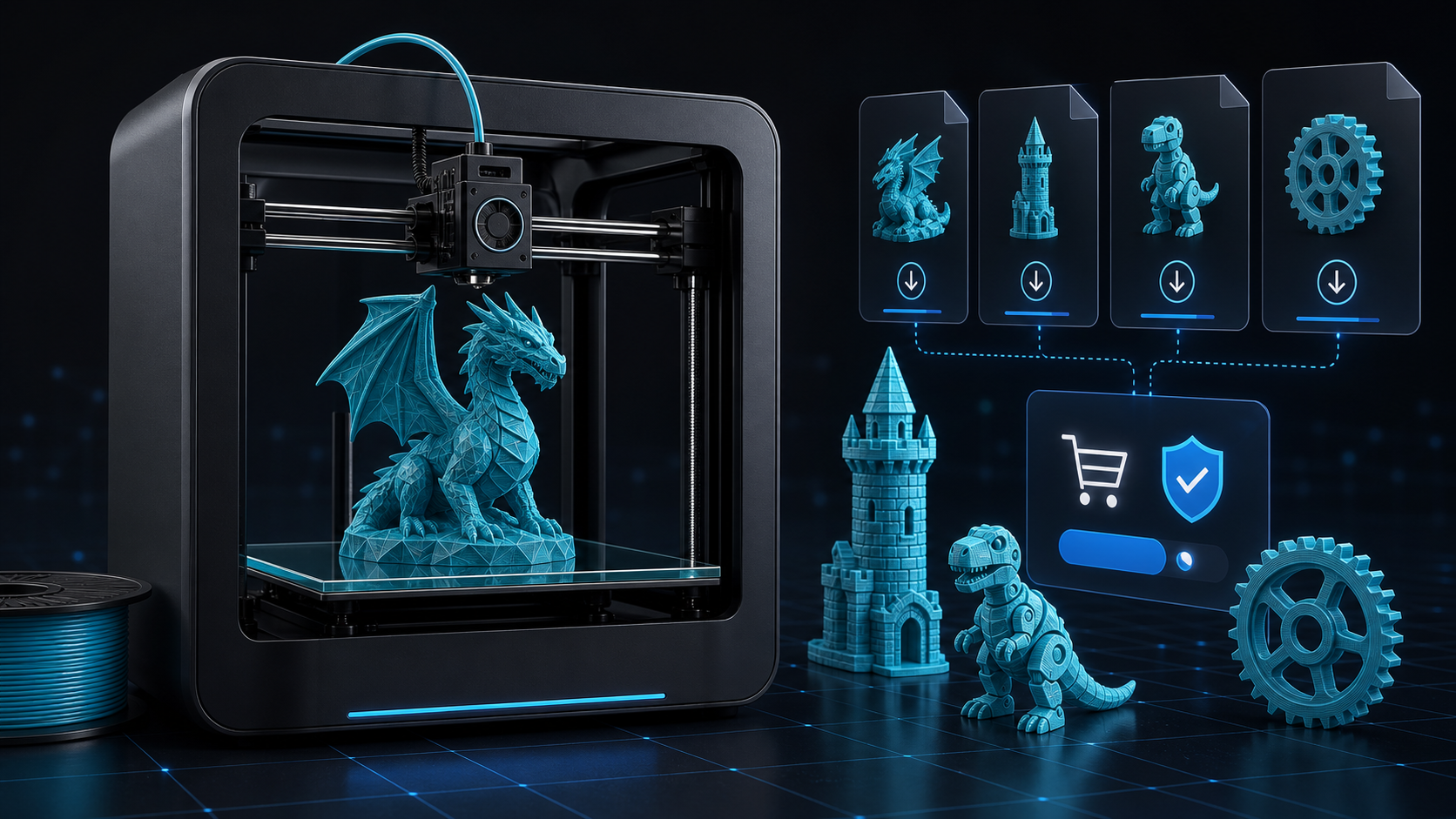
Selling an STL file is different from sharing one for free. You need a product page that explains what the model does, preview images that prove it prints well, license terms that protect your work, a checkout your buyers trust, and reliable file delivery after payment.
The best platform depends on where your customers come from. A specialist 3D-printing marketplace can bring discovery from people already searching for models. A direct-selling platform gives you more control over your brand, customer relationship, pricing, and checkout link. Many established designers use both: marketplaces for discovery and a direct store for their audience and client work.
This guide compares practical options for selling STL files in 2026. Fees and programs change, so verify the current terms on each platform before publishing.
Quick Comparison
| Platform | Best for | Selling model | Main trade-off |
|---|---|---|---|
| PayRequest | Direct sales, client delivery, your own audience | 2% per successful payment, capped at €25, plus provider fees | You bring the traffic |
| Cults3D | Broad 3D-printing marketplace discovery | Creator receives 80% of net selling price | Higher marketplace commission |
| MyMiniFactory | Miniatures, tabletop creators, memberships | Tier-based platform fee plus processing | Creator plans and fee structure |
| CGTrader | 3D assets plus print-ready models | Up to 85% earnings based on performance | Less exclusively focused on printing |
| Etsy | Buyers searching for craft and printable products | Listing, transaction, payment, and possible advertising fees | Crowded marketplace and layered fees |
| Gumroad | Simple creator storefront and existing followers | Per-sale platform fee plus payment processing | Limited specialist STL discovery |
1. PayRequest: Best for Direct STL Sales
PayRequest is a strong option when you already reach buyers through a portfolio, social media, Discord, email, a community, or direct client work. Upload your STL package, set a price, create a product page, and share one checkout link. Payment confirmation and digital delivery happen automatically.
Unlike a specialist marketplace, PayRequest is not trying to rank your model among thousands of competing files. That is the advantage and the limitation. You control how you present the product and send buyers straight to your offer, but you are responsible for attracting them.
PayRequest includes every selling feature on the Free plan and charges 2% per successful payment, capped at €25 per transaction, in addition to the processing costs of your connected provider. You can connect supported fiat providers and offer crypto payment options, making it useful for international communities and direct CAD commissions.
Best for:
- Designers with an existing following or niche community
- Client-specific STL, STEP, DWG, or F3D delivery
- Bundles, commercial licenses, and higher-priced model libraries
- Sellers who want a branded direct checkout link
- Creators who want fiat and crypto payment options
The main downside is discovery: a direct storefront does not replace marketplace search traffic. Use useful previews, tutorials, social posts, mailing lists, and search-optimized landing pages to build demand.
2. Cults3D: Best for Broad STL Marketplace Discovery
Cults3D is built around downloadable fabrication files and has a large audience looking for STL, OBJ, CAD, 3MF, CNC, and related designs. Opening a seller account and uploading models does not require a subscription.
According to the official Cults creator page, designers receive 80% of the net selling price excluding VAT, while Cults allocates 20% to its commission and banking costs. The platform provides search, categories, creator profiles, customer accounts, updates, licenses, and a checkout with multiple payment methods.
Best for:
- Getting models in front of an existing maker audience
- Functional parts, decor, cosplay, toys, accessories, and general STL categories
- New designers testing which concepts attract downloads
- Sellers who prefer a commission model with no fixed subscription
The trade-off is the 20% share and less control over the buyer journey. Marketplace visibility is also competitive; good renders, printed photos, descriptive titles, tags, and a dependable release history matter.
3. MyMiniFactory: Best for Tabletop and Membership-Led Creators
MyMiniFactory is closely associated with tabletop miniatures, terrain, collections, campaigns, and creator communities. It is particularly relevant when your business is not only individual file sales but recurring releases and engaged collectors.
Its current Store Manager fee documentation lists platform fees by creator tier—15% for Upcoming, 12.5% for Pro, and 10% for Studio—plus payment processing. Plans and eligibility affect the total economics, so calculate costs using the tier you can actually access.
Best for:
- Tabletop miniatures, terrain, busts, and monthly collections
- Creators building memberships around regular releases
- Launches that benefit from a specialist collector audience
- Studios with a substantial catalog
The fee model is more involved than a single percentage. Check creator-plan costs, processing charges, payout terms, and the tools included at each tier before committing your full catalog.
4. CGTrader: Best for Selling Beyond STL
CGTrader serves a wider professional 3D market, including visualization, games, AR/VR, and print-ready files. That makes it useful if the same asset can be sold in STL together with OBJ, FBX, Blender, or CAD formats.
The official CGTrader seller page says uploading is free and creators can earn up to 85%, with the payout rate based on sales performance over the preceding 12 months. It also offers royalty-free and editorial licensing options.
Best for:
- Models useful both on screen and as physical prints
- Professional asset creators with several export formats
- Large catalogs that benefit from bulk publishing tools
- Designers targeting buyers outside the hobby-printing niche
The audience is broader, so a model intended only for a particular printer or tabletop use case may fit a dedicated printing marketplace better. “Up to 85%” is also not the same as a guaranteed rate for every new seller.
5. Etsy: Best for Reaching Craft Buyers
Etsy can expose digital STL listings to shoppers already buying craft supplies, patterns, personalized products, and printable designs. It can work for cookie cutters, organizers, doll accessories, cosplay pieces, decor, and models connected to a physical-making niche.
Etsy's advantage is buyer demand beyond the core 3D community. Its disadvantages are competition, layered fees, limited specialist model presentation, and the risk that customers do not understand they are buying a digital file rather than a finished print.
Best for:
- Consumer-friendly designs with clear visual outcomes
- Products that overlap crafting, events, personalization, or home decor
- Sellers already operating an Etsy shop
State “digital download, no physical item” prominently. Confirm current listing, transaction, payment-processing, currency-conversion, regulatory, and advertising charges for your country in Etsy's official fee documentation before pricing.
6. Gumroad: Best for a Fast Creator Storefront
Gumroad offers a familiar way to sell downloads to an audience you already have. It supports product pages, checkout, delivery, email updates, and creator-focused commerce without requiring a full website.
It is easy to launch, but it provides limited native discovery for people specifically searching for printable models. Compare its current per-sale fees and tax handling with a direct platform and specialist marketplaces, especially when selling low-priced individual files where fixed or percentage costs have a bigger effect.
Best for:
- Creators already using Gumroad for other digital products
- Simple bundles promoted through social channels
- Audiences familiar with creator storefronts
Marketplace or Direct Store: Which Should You Choose?
Choose a marketplace first when you have no audience and need search discovery. A marketplace can validate whether buyers want your models, but it charges for access to that audience and controls more of the customer experience.
Choose a direct store when customers already know you, when a client requested the work, or when you sell higher-value bundles and licenses. Direct selling lets every portfolio link, tutorial, and community post point to a focused product page.
A hybrid setup is often strongest:
- Publish selected products on a marketplace for discovery
- Build your own audience through useful content and free samples
- Sell exclusive bundles, client files, and expanded licenses directly
- Follow each platform's rules about links, customer data, and off-platform transactions
Do not use a marketplace to acquire a buyer and then violate its anti-circumvention terms. The goal is to develop independent demand ethically, not divert an in-progress marketplace sale.
What to Include in an STL Product
A polished download is more than one STL file. Include what a buyer needs to evaluate, print, and legally use the model:
- Tested STL files with sensible orientation and unambiguous names
- 3MF files when they preserve useful layout or print settings
- Supported and unsupported variants for resin miniatures where appropriate
- STEP or editable source files for engineering products when promised
- Dimensions, scale, units, tolerances, and assembly instructions
- Printer, material, layer-height, support, and infill recommendations
- Rendered previews plus photos of a real successful print
- Version number, changelog, and contact route for genuine file defects
- A clear personal or commercial license
If you work in Fusion 360, the guide to selling Fusion 360 F3D and STEP files explains how to package editable source designs. For drafting templates and fabrication drawings, see how to sell AutoCAD DWG files.
How to Price 3D Printing Files
Price according to buyer value, complexity, testing, and license scope—not only modeling hours. A tiny replacement part that saves an unavailable machine may be worth more than a visually complex decorative model.
Consider separate offers:
| Offer | What the buyer receives |
|---|---|
| Personal license | Files for the buyer's private prints |
| Commercial print license | Permission to sell physical prints under defined conditions |
| Source-file bundle | STL plus editable CAD or sculpting source files |
| Collection | Several related models at a lower combined price |
| Membership | Regular releases and continuing access under stated terms |
Never promise that a model is safe for food, children, medical use, structural loads, or regulated applications unless you have appropriate evidence and are legally able to make that claim.
Protecting Your STL Files
No download platform can make a delivered file impossible to copy. Focus on clear rights, trustworthy customer relationships, and a release process that makes the legitimate product more useful.
- Put the license in the ZIP and summarize it on the product page
- Keep dated source files and evidence of your design process
- Use lower-resolution or watermarked previews, not watermarks that damage the purchased mesh
- Define whether buyers may sell physical prints
- Explain whether remixing is allowed and whether attribution is required
- Avoid characters, logos, and products you do not have rights to sell
For many creators, helpful documentation, updates, organized files, and responsive defect fixes are stronger advantages than technical restrictions that frustrate legitimate buyers.
Final Verdict
There is no single best platform for every STL seller in 2026.
- Choose PayRequest for direct sales, client delivery, controlled branding, and fiat or crypto checkout
- Choose Cults3D for broad specialist marketplace reach with a straightforward commission model
- Choose MyMiniFactory for tabletop collections and a membership-centered creator business
- Choose CGTrader when your assets extend beyond 3D printing into professional 3D formats
- Consider Etsy for craft-oriented consumer demand and Gumroad for an existing creator audience
Start where your buyers already search, then build a direct audience you control. The durable business is not just a folder of STL files—it is a recognizable niche, dependable print quality, clear licensing, and a buying experience people trust.