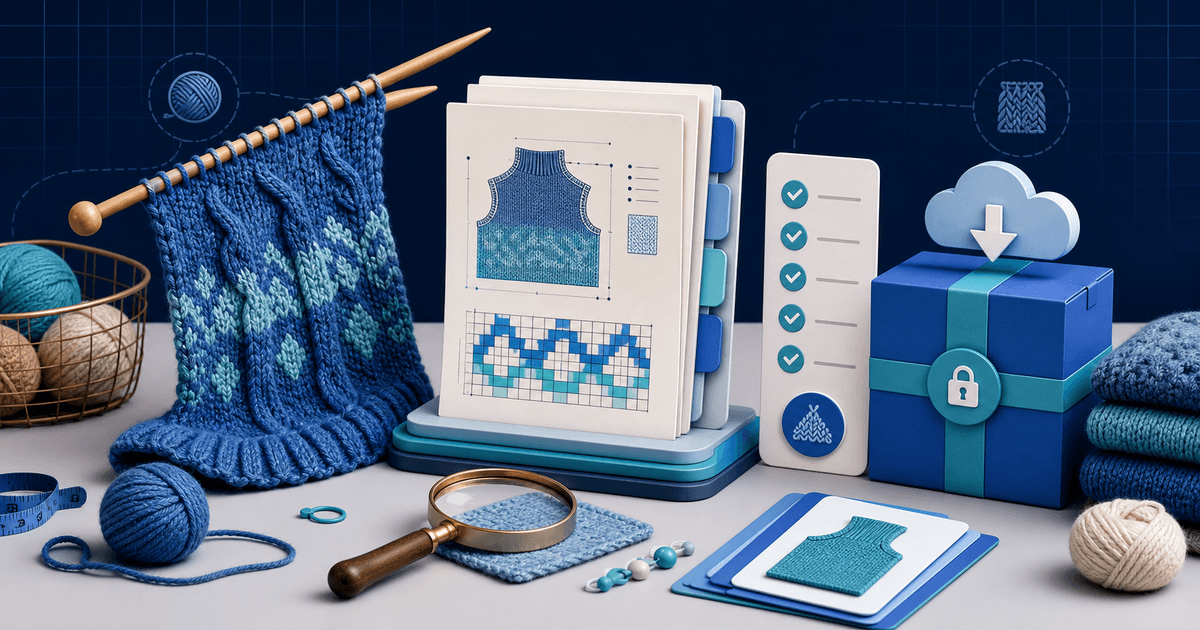
To sell knitting patterns online, turn your sample into a tested PDF that another knitter can complete without private explanations. Specify yarn, gauge, measurements, skills and terminology; test every size; photograph the finished object honestly; and deliver a versioned file with clear usage terms after payment.
The product is not merely the idea for a garment. It is a reliable set of instructions. This release checklist helps you find expensive ambiguity before customers do.
Define the Knitter and Finished Result
Name the construction, intended fit and required skills before writing. “Beginner” is too vague on its own. State whether the knitter must work in the round, read charts, manage colorwork, shape a neckline or sew pieces together.
Your opening information should include:
- finished measurements and intended ease;
- size range and which measurements choose the size;
- yarn weight, fiber assumptions and total quantity by size;
- needle sizes as a starting point, not a substitute for gauge;
- gauge measurement after any washing or blocking step;
- notions, abbreviations, techniques and language or terminology standard.
Put critical requirements before the instructions. A buyer should know whether the project suits them before purchasing yarn.
Write Instructions That Survive Without You
Use consistent abbreviations and distinguish a stitch count from a repeated instruction. Provide stitch counts after shaping rows so knitters can catch an error early. When a chart and written directions describe the same section, confirm that both produce the same result.
Avoid layout choices that create printing mistakes. Keep important chart keys with the chart, label page numbers and pattern version, and use strong contrast. If pages may be printed, test in grayscale and at normal paper size.
Use This Pattern Release Checklist
| Check | Evidence to keep | Release standard |
|---|---|---|
| Sample | Finished object and notes | Matches the published instructions |
| Gauge | Swatch before and after finishing | Measurement and method are explicit |
| Size grading | Stitch and row counts by size | Counts reconcile at every shaping stage |
| Technical edit | Marked-up independent review | Ambiguities and inconsistencies resolved |
| Test knit | Feedback by size and experience | No unresolved blocking issue |
| Phone, desktop and printed copy | Links, charts, contrast and page order work | |
| Download | Fresh purchase and unzip test | Correct version arrives after payment |
A test knitter is not a replacement for technical editing. Testers show how real knitters interpret the pattern; a technical editor checks logic, consistency, math and presentation. Tell testers the deadline, expected feedback, size, yarn responsibility, confidentiality and how their work may be credited.
Test Sizes Without Inventing Proof
You do not need a staged photo for every size to publish responsibly, but you should not claim every size was test-knit when it was not. Record which sizes were sampled, technically checked and independently tested. Review edge sizes with extra care because grading errors compound away from the sample size.
When feedback changes a stitch count, trace the change through later totals, charts and finishing. Maintain one source document so an old correction does not reappear in another export.
Build a Buyer-Friendly PDF Package
Use a descriptive filename such as harbor-cardigan-v1-0-en.pdf. Include a low-ink copy only if it genuinely removes ink-heavy photography or backgrounds without losing necessary diagrams. For translated patterns, label language files clearly.
Ravelry's official designer help confirms that patterns offered through its store are uploaded as PDFs and can support additional language files. That makes PDF a practical delivery format, but your own direct store gives you control over checkout, customer communication and where the pattern is promoted. See Ravelry's designer help when distributing there as well.
The download can contain:
- the current pattern PDF;
- a printer-friendly PDF when useful;
- a short license and support note;
- an accessible text alternative for information that otherwise exists only in charts, when feasible.
Do not include copied patterns, unlicensed photographs, charts or branded characters. If another person created photography, illustration, grading or technical editing, agree on usage and credit before sale.
Set Clear Pattern and Finished-Item Terms
Tell buyers whether they may print copies for personal use, store the file on their own devices and sell finished objects made from the pattern. Separately prohibit sharing, reselling or republishing the PDF unless you intend otherwise.
Rules around patterns, instructions and finished objects vary by jurisdiction and the specific material involved. Avoid universal copyright claims in your listing; obtain legal advice for important licensing questions.
Price, Preview and Support the Pattern
Price according to complexity, size range, editing, testing, diagrams and support—not only page count. Show the finished object from useful angles and list the information a knitter uses to judge fit. Do not reveal the entire instruction set in preview images.
Publish an errata and update process. When a correction affects the result, increment the version, replace the download and tell prior buyers how to obtain it. Keep support focused by asking for pattern version, size, current row or round, stitch count and a photo where helpful.
With PayRequest knitting-pattern downloads, you can sell the finished PDF from a hosted page and deliver it automatically after successful payment. Complete the release checklist, upload the versioned file and make a fresh test purchase before announcing the pattern.