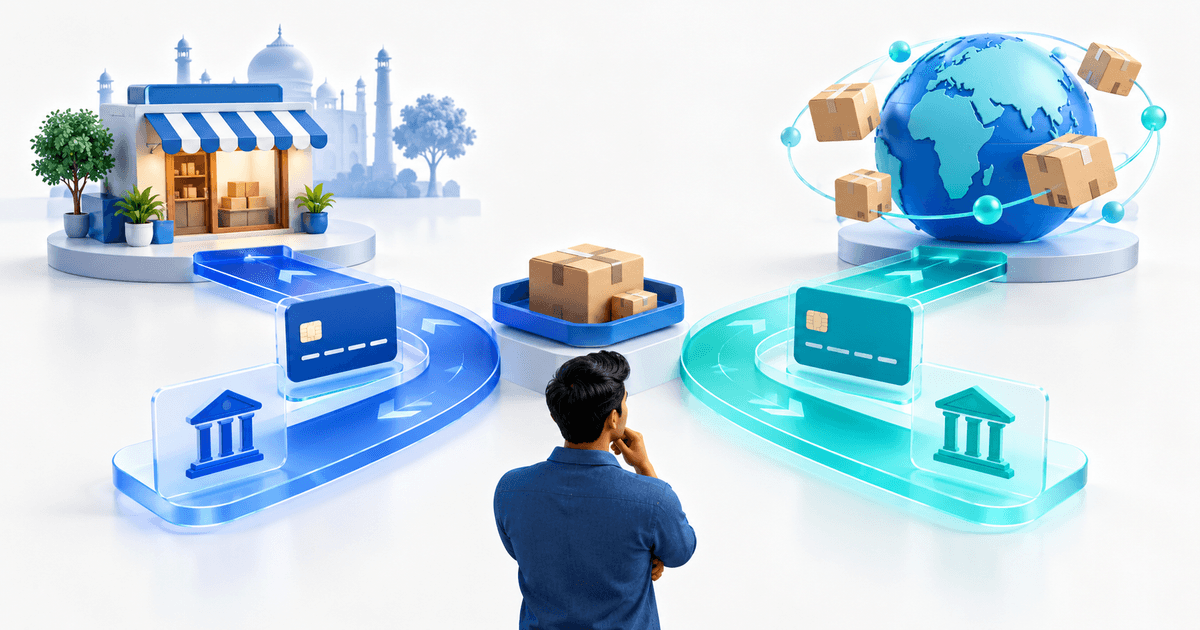
For an Indian seller, PayPal and Razorpay are not interchangeable domestic-payment options. PayPal says Indian accounts cannot receive domestic payments; they can receive international payments. Razorpay offers payment links with Indian payment methods including UPI, subject to merchant onboarding and method availability. Choose by customer location and payment job before comparing headline fees.
This guide is for sellers choosing a collection workflow for local customers and overseas clients. It is not a method for bypassing provider restrictions, and PayRequest does not provide a Razorpay integration in this comparison.
Start with eligibility, then checkout
PayPal's India help page explicitly excludes domestic receiving. That rule still applies when a payment originates from an invoice, shop or third-party payment link.
Razorpay's payment-link documentation lists cards, UPI, NetBanking and other payment options. It also documents due dates, reminders and partial payments. Confirm which methods and international acceptance are enabled for your own account before promising them to buyers.
| Seller requirement | PayPal route | Razorpay route |
|---|---|---|
| Receive from Indian domestic customers | Not supported for Indian PayPal accounts | Assess eligible domestic methods and onboarding |
| Collect from overseas customers | Check account, country and currency eligibility | Check international acceptance approval and currencies |
| Send a no-code checkout link | PayPal offers merchant links where available; confirm India availability | Documented payment-link workflow |
| Allow an order to be paid in parts | Verify the exact invoice or product offering; do not infer it from a generic link | Partial payments documented for supported links |
| Deliver a digital file after payment | Evaluate fulfilment separately | Evaluate fulfilment separately |
| Collect future renewals automatically | Requires a separate supported recurring agreement | Evaluate the subscription product separately |
PayPal's merchant payment-link documentation describes product details and a hosted checkout. It is a real merchant product, not simply PayPal.Me. Its global documentation does not establish that every feature or wallet is available to an Indian merchant.
An eighty-order collection worksheet
Imagine a seller with sixty domestic orders priced at ₹1,000 and twenty export orders priced at US$50 in a month. These are hypothetical inputs, not measured sales or expected results.
| Order group | Gross amount | Collection decision |
|---|---|---|
| 60 Indian domestic orders | ₹60,000 | Use an eligible domestic route; Indian PayPal receiving is excluded |
| 20 overseas orders | US$1,000 | Compare eligible PayPal and Razorpay international offers |
| A split-payment domestic order | ₹1,000 total | Track first payment and remaining balance; verify supported partial-payment flow |
Keep ₹60,000 and US$1,000 as separate totals. Adding them produces a meaningless revenue or fee comparison. Request the international settlement currency, conversion spread, fixed charge and any applicable tax alongside the percentage rate.
For each eligible route, calculate order count × (order value × quoted percentage + quoted fixed charge) in the charge currency. Add conversion and other applicable charges separately. An ineligible route cannot become cheaper through a spreadsheet.
If one ₹1,000 order is paid ₹400 first, the remaining amount is ₹600. Confirm whether the same payment link records that balance or whether your system creates a separate request. Two payments are still one order. A partial payment must not trigger full delivery if your terms require the full amount first.
Compare the work after payment
Before choosing, write down who confirms payment, sends a receipt, fulfils the order and handles a refund. A payment link solves checkout; it does not by itself establish file delivery, stock reservation or service scheduling.
For a bespoke service, a client-specific invoice may be clearer than a reusable product link. For downloads, check that fulfilment follows a confirmed payment and that the purchased file matches the order. For recurring services, choose a consented recurring-payment workflow rather than treating repeated one-off links as automatic collection.
Do not fulfil from a buyer's screenshot alone. Confirm the completed payment in your provider or collection system, including order reference, amount and currency. Keep refund and dispute responsibilities explicit when two collection routes serve the same business.
Where PayRequest helps a PayPal seller
If PayPal is eligible for the customer and transaction, PayRequest payment links provide a hosted collection workflow with a connected PayPal Business account. Review accepting PayPal in India for the country-specific route. PayPal's receiving restrictions and account approval still apply; connecting PayRequest does not enable domestic PayPal collection or add Razorpay methods.
PayRequest pricing separates its platform charge from provider processing fees: Free is €0/month with a 2% standard payment fee; active Premium (€5/month) and Business (€20/month) have 0% standard platform fees. Commission-payment exceptions and provider fees remain separate. Select paid features only when your workflow needs them; signup alone does not activate a paid plan.
For an eligible overseas order, create an account, connect your PayPal Business account and prepare one payment link with a clear amount, supported currency and order description. Keep domestic collection with a provider that can serve it.
*Method: published provider information checked on 28 October 2026 and an original hypothetical order-routing worksheet. Prepared with AI assistance and editorial review; no merchant-account test, fee quote or conversion result is claimed.*