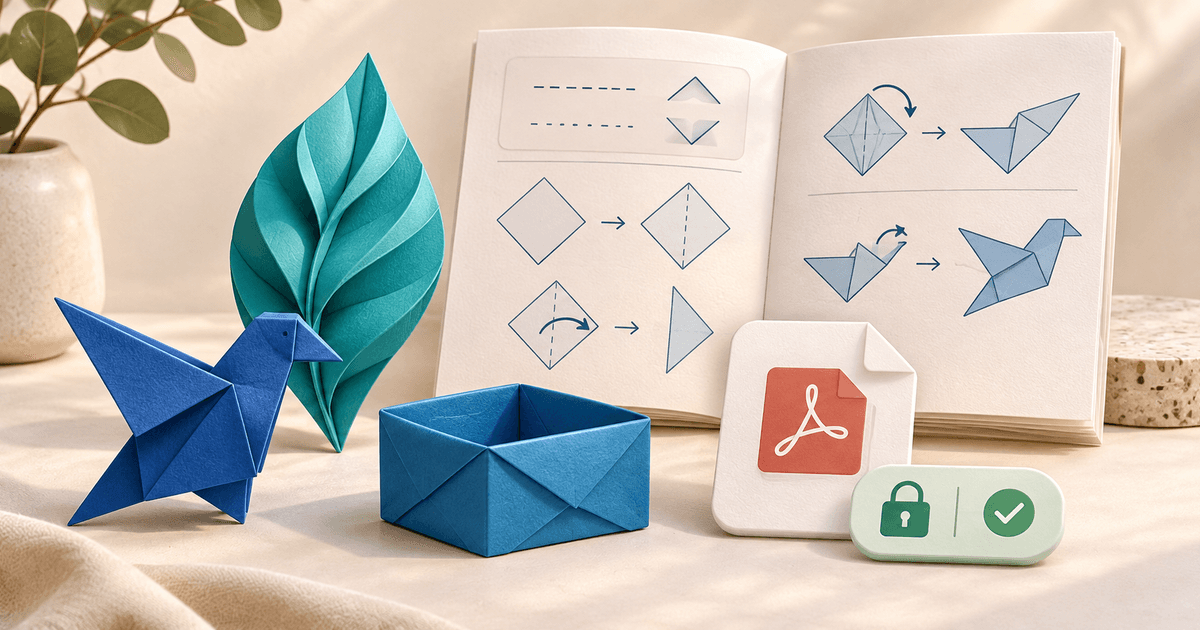
You can sell original origami diagrams as a PDF booklet or individual download when you have the rights needed to publish the models, drawings, photographs and instructions. A useful paid product tells a folder what they can make, what paper and skills they need, and whether they can follow every step without your help.
Here is a hypothetical three-model booklet. It is a planning example, not an actual product, folding test or sales result. The numbers make the decisions reproducible; substitute your own verified models and costs before selling.
Start with one coherent folding promise
Assume a designer plans three original single-sheet models for folders who already understand basic crease symbols. Each uses one 15 cm square. There are no cuts, glue or modular assemblies in this particular proposed edition. Those are explicit scope choices, not rules for all origami.
The offer is a digital instruction booklet, not paper, a finished sculpture or live tuition. If a model needs a particular paper weight, starting shape or tool, disclose that instead of letting the attractive cover imply an easier project.
Paid diagrams are an established commercial format: Paper Kawaii sells PDF diagrams and ebooks. A BOOTH origami listing distinguishes the language of the description from the language of the diagrams. That distinction matters: an English sales page does not make every instruction inside an English-language product.
Allocate the booklet before setting its price
Use the following invented page budget to expose missing parts. Page numbers refer to the proposed file, not to a downloadable booklet supplied with this article.
| Pages | Planned content | Count |
|---|---|---|
| 1 | Cover and three finished-model previews | 1 |
| 2–3 | Paper, symbols, orientation and skill prerequisites | 2 |
| 4–7 | Model A, complete sequence | 4 |
| 8–12 | Model B, complete sequence | 5 |
| 13–18 | Model C, complete sequence | 6 |
| 19 | Troubleshooting and support details | 1 |
| 20 | Rights, permitted uses and edition information | 1 |
The total is 1 + 2 + 4 + 5 + 6 + 1 + 1 = 20 pages. Three models do not mean three pages. A model that needs extra diagrams should receive them; do not reduce step clarity to preserve a marketing page count.
A free sample could contain the symbol key and the complete four-page Model A sequence: five pages if the key occupies one separate sample page. Label it as one complete sample model. Do not count those five pages as five extra paid models, or imply that buyers receive content absent from the retail file.
Build a fold-state proof, not just a print check
For each model, record the starting paper, the orientation at each difficult transition, the layer being moved and what the completed step should look like. Ask a suitable independent folder to work from the exported retail PDF without spoken hints. This is a recommended validation process; we have not performed it for the invented booklet.
| Check | Evidence to record | Release decision |
|---|---|---|
| Orientation | Front/back shading, rotation and turn-over steps | Fix ambiguous views before selling |
| Sequence | Every reference crease and intermediate state exists | Add the missing transition |
| Paper | Actual starting size, paper type and observed difficulty | State the tested combination only |
| Language | Diagram labels, captions and symbol key checked separately | Name every included language accurately |
| Independence | Folder's questions linked to the affected step | Revise and repeat unclear steps |
Avoid stating that a model is “beginner” merely because it starts from a square. Show prerequisites such as reverse folds when they are required. Photographs can support a tricky transition, but a cover image is not evidence that the full sequence works.
Make finished-size claims traceable
Suppose the designer later measures a finished model at 6 cm wide from a 15 cm square. The observed ratio would be 6 ÷ 15 = 0.4. A 20 cm square would suggest an 8 cm width at the same proportions: 20 × 0.4 = 8 cm.
That is an illustrative scaling calculation, not a tested claim. Paper thickness and folding accuracy can affect the actual result. State the measured model, starting square and approximate result together. Do not sell “fits any paper size” based only on proportional geometry.
Keep permissions separate from a credit line
Use your original models and illustrations, or obtain permission that covers the actual commercial distribution. Giving a designer credit is not a substitute for the necessary rights. Permission to fold and sell a physical model is a different question from permission to sell its diagrams.
PrwOrigami's FAQ illustrates that individual creators publish their own sharing and commercial-use policies and distinguish work by other artists. Read the policy for the actual work; it is not a universal license for origami.
Write the buyer's usage terms plainly: personal printing, classroom copies if allowed, finished-model sales if allowed, and restrictions on redistributing the PDF. Obtain appropriate advice for your jurisdiction when rights are uncertain. Avoid claiming that a payment platform creates copyright protection.
Price the edition with visible assumptions
Assume a €9 price and 20 hypothetical standard payments in one month. Gross customer payments would be €180. On PayRequest Free, 2% of each €9 payment is €0.18, giving €3.60 in standard platform fees and €176.40 before provider fees, taxes, refunds and production costs.
This is arithmetic, not predicted demand or profit. An active Premium subscription is €5/month and Business €20/month, with 0% standard platform fees while active. At this illustrative volume, the €3.60 Free platform fee is below the €5 subscription alone; other features may still matter. Provider fees and commission-payment exceptions are separate. See current plans.
Publish the checked PDF, then show the real offer
Create a PayRequest digital product for the final PDF, connect an eligible payment provider and state the included models, page count, language, prerequisites and usage terms. Digital products are available on Free; a paid subscription is not required simply to sell this download.
Use a version such as booklet-1.0.pdf and preserve that edition with its support notes. Review the buyer page, confirmed payment path and delivery instructions before promotion. Uploaded files are delivered after confirmed payment; PayRequest does not validate your diagrams, supply folders or guarantee an audience. Say how corrections will be communicated without promising lifetime access or automatic updates you have not arranged.
The booklet is ready to sell when the files, the folding promise and the product description agree—not when the cover alone looks finished.
Editorial note: AI assisted with this article and its illustrative cover. All models, counts, measurements and sales quantities above are hypothetical planning inputs. No diagram booklet, physical folding test, live payment or customer result was produced. Sources reviewed on 10 November 2026.