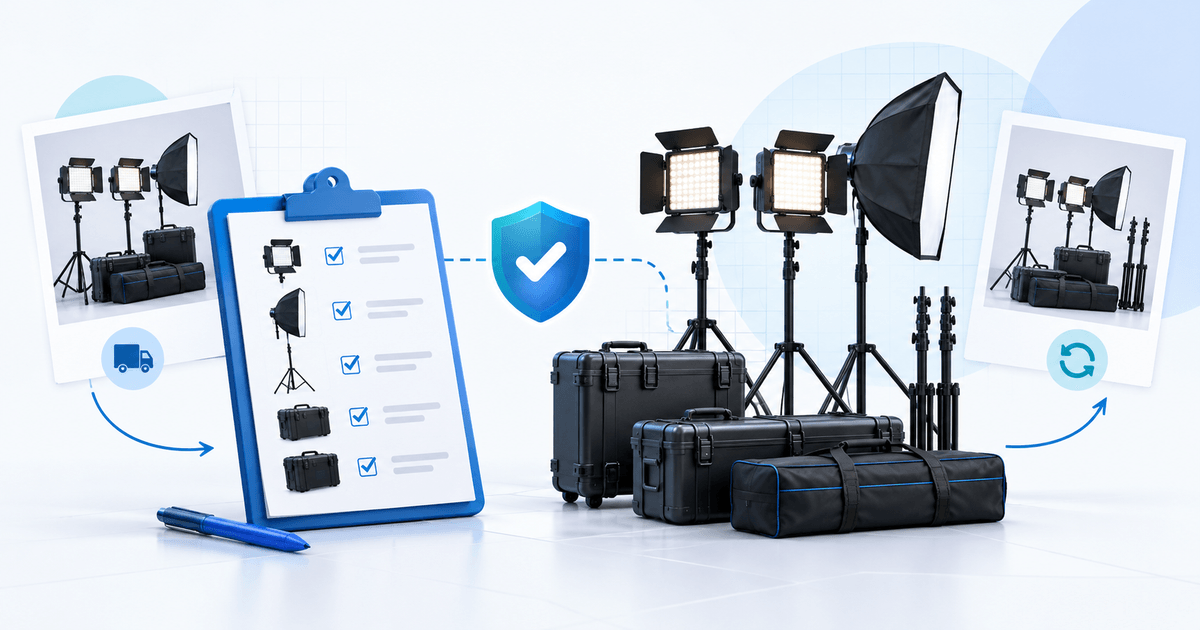
A lighting-equipment rental security deposit should connect each light, modifier, stand and case to a repeatable power-and-return inspection. Keep the rental fee, temporary authorization, insurance decision and later damage assessment separate. A deposit is evidence-backed protection for a defined custody risk, not a shortcut around safe electrical checks or clear rental terms.
This workflow is for small film, photography and event-lighting rental companies serving creators, agencies and productions. The narrower job is different from a generic equipment-rental checklist: lighting kits combine serialised electronics, fragile modifiers, stands and power accessories whose condition cannot be reconstructed from one wide photo.
What should the deposit record contain?
Give the booking a kit ID and list every item that could create a handover question. Record serial or asset numbers where useful, the agreed custody window, the rental amount, the deposit or authorization amount, the connected provider and the conditions for release or supported capture.
| Zone | Handover evidence | Return question |
|---|---|---|
| Light head | Model, asset ID, housing and mount photos | Same unit and no new housing or mount damage? |
| Power | Cable, connector, battery or ballast and test result | Does the same safe power path work? |
| Modifier | Softbox, grid, reflector and frame count | Are the pieces complete and usable? |
| Support | Stand, clamp, sandbag and case | Are load-bearing parts and bags present? |
| Dispatch | Timestamp, staff member and renter acknowledgement | Can another person match the kit later? |
The matrix is an original operational template, not a safety certification. Quarantine equipment when a qualified person needs to assess it. Do not make a capture decision from a cosmetic photograph when the functional state is unknown.
Separate a card hold from a collected deposit
A card authorization temporarily reserves an amount and may later support a capture or release when the provider, payment method and timing allow it. A collected deposit is a payment that normally needs a refund or other documented return path. Stripe's authorization documentation explains why holds are time-limited; confirm the actual support and expiry window for the provider connected to your account.
Do not advertise a universal hold duration or promise that every card and country supports the same capture path. Put the amount, expiry condition, inspection process and customer notice in the rental agreement. Never call a released authorization a refund when the money was never settled as a charge.
Run the same test before dispatch and after return
Use a matched test card rather than improvising at return. For a fictional two-light kit, the sequence might be:
- Photograph the kit ID, serials and existing marks in context.
- Power each light through the declared safe setup and record the visible result.
- Check the mount, modifier, stand lock, cable and case for the listed kit.
- Have the renter acknowledge the starting state and custody window.
- Repeat the same checks at return, separating ordinary wear, missing items and new damage.
- Reconcile the inspection with the provider status before releasing or capturing any supported amount.
The value is repeatability. If one staff member uses a different test at return, the record becomes a story instead of a comparison. A failed light at return is not automatically proof of renter damage; preserve the evidence and obtain the appropriate technical assessment.
Make the financial decision item by item
For an illustrative €900 authorization, a documented €75 missing clamp would not automatically justify capturing €900. The working record should name the clamp, connect it to the handover inventory, cite the disclosed term and show the supported action. The remaining amount is released only through the provider path that actually applies. This is arithmetic, not a recommended deposit or legal outcome.
Send the renter an itemized result: clean return, open technical review, supported partial capture or release. Keep the original handover record, provider reference and customer message together. Do not overwrite the starting photos after a dispute.
Configure the PayRequest route and rehearse it
Use PayRequest security deposits for the configured authorization, status, release and supported capture workflow. Use payment links for a focused rental fee or balance when that matches the connected provider. Keep the kit inventory, safety assessment and rental agreement in the operational record that owns them.
Before sharing the route, test a successful payment, an abandoned checkout, a clean return, a missing accessory and a return that needs technical review. PayRequest can support the configured payment route; it does not certify electrical safety, provide insurance or decide whether a deduction is enforceable. Review pricing: the Free plan has no monthly charge and PayRequest charges 2% per successful payment, capped at €25 per transaction; provider fees remain separate.
Measure complete handover cards, inspection-to-release time, unmatched kit IDs, technical-review rate and disputed deductions. A higher hold is not proof of better control. A matched dispatch-and-return record is the useful operating asset.
Editorial note: AI assisted with this article and its illustrative cover. The zone matrix, matched test sequence and €900/€75 arithmetic are original planning tools; no live authorization, capture, rental deployment or legal conclusion is claimed.