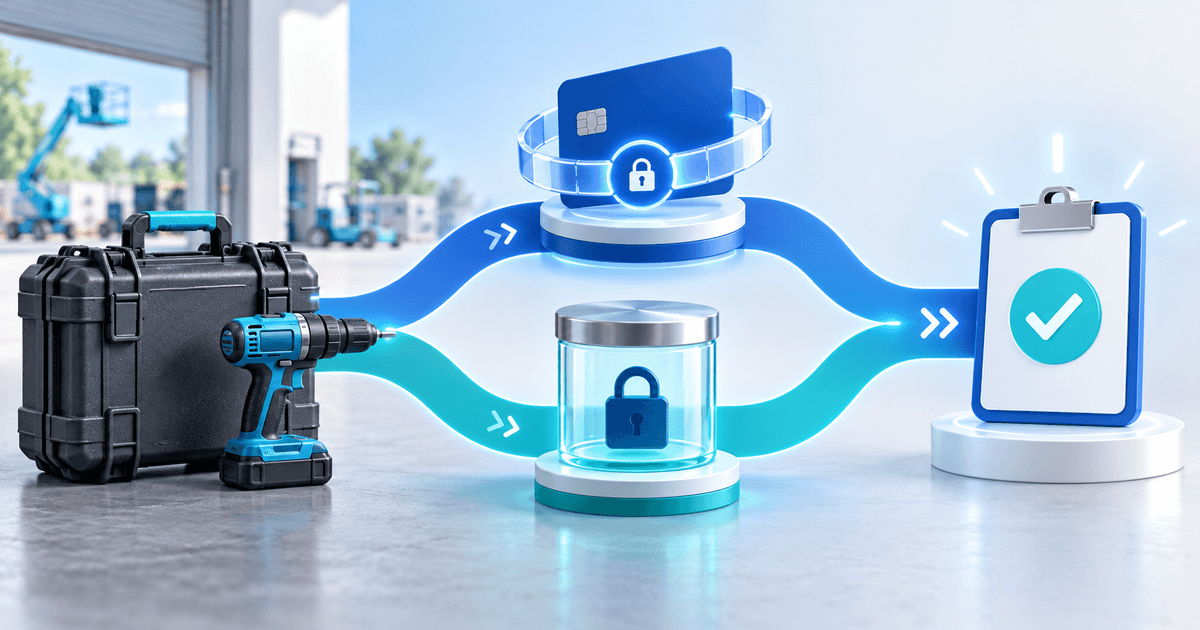
Choose a security-deposit authorization when your rental business needs an agreed amount reserved before handover. Choose a card-on-file arrangement only when you are comfortable attempting an authorized charge later without reserving that amount now. Neither approach guarantees recovery of every loss.
For an equipment or event-rental operator, the buying question is not simply “Can this software save a card?” It is “What financial state will exist when I hand over the equipment?” A saved credential, an active hold and a completed deposit payment answer that question differently.
Compare the three money states
| Workflow | What happens at setup? | What happens after return? | Main buying condition |
|---|---|---|---|
| Card on file | A provider stores a payment credential for permitted future use; the agreed security amount is not necessarily reserved | A new charge is attempted under the customer's agreement | Future consent, authentication and payment failure must be handled |
| Security-deposit authorization | The approved amount is reserved, reducing the customer's available balance | Release unused security or capture a justified amount before expiry | Actual authorized amount and deadline must cover the decision |
| Collected refundable deposit | Money is charged and settles through the payment route | Refund the unused amount under the agreed process | Refund handling, costs and any custody requirements must fit |
Stripe's Setup Intents documentation describes saving a payment method for future payments without creating a charge. Its authorization documentation describes reserving funds and capturing before expiry. A successful card-setup event is not proof of an active €500 reservation.
Some rental businesses deliberately choose card-on-file recovery. AidersPlus states that distinction explicitly in its own policy. That illustrates a commercial choice, not a legal template or a recommendation that every operator should use the same policy.
Work through a €300 rental with €500 security
Imagine a fictional weekend equipment hire: €300 hire fee, €500 agreed damage security and return inspection on Monday. The hire fee is paid separately. These amounts are examples, not suggested deposit levels.
| Outcome | Card on file | Confirmed €500 authorization |
|---|---|---|
| Equipment returns with nothing owed | No damage charge is needed | Release the €500 hold |
| €90 of agreed, documented costs | Attempt a new €90 payment using the permitted route; it can require confirmation or fail | In PayRequest's current Stripe flow, a final €90 capture releases the unused €410 |
| Inspection happens after hold expiry | Card-on-file recovery still depends on an eligible new payment attempt | The expired authorization cannot be captured |
| Loss exceeds the security amount | Stored details do not establish available funds or unlimited charging rights | The hold only reserves its authorized amount; additional recovery needs a separate appropriate basis |
Neither a card nor a deposit substitutes for an agreement, condition records, a justified deduction or insurance where required. Do not capture the entire security simply because it is available. PayRequest's current Stripe partial capture is final: you cannot repeatedly collect further amounts from the released remainder.
Download the rental-security decision worksheet. Use it to record whether funds must be reserved, the actual provider status, inspection owner and deadline. It is a buying checklist with a fictional example, not an authorization form or payment record.
Ask these questions before you buy rental payment software
- Does “deposit collected” mean saved, authorized or charged? Ask for the actual provider status and amount, not only a reassuring badge.
- Can I confirm security before releasing the equipment? A link sent, a completed card form or a scheduled future hold is not a confirmed reservation.
- What if the future charge fails? Understand customer confirmation, declines, notifications and the alternative collection process.
- Will the real deadline cover inspection? Use the authorization planner with the transaction's actual deadline, return time and review buffer.
- Who closes the case? Assign release, evidence review, final capture and the customer's explanation to a named person.
ChargeAutomation's documented statuses distinguish a scheduled deposit with a card on file from an authorized, funded deposit. Apply that same status-level scrutiny when evaluating any supplier. Labels and capabilities vary; do not assume all tools implement the same mechanism.
When PayRequest deposit links fit
PayRequest security-deposit links are worth evaluating when your booking or hire process already works and you want a hosted authorization, capture and release workflow with an eligible Stripe account. The customer authorizes the deposit through the secure payment page; your business checks the resulting status and deadline before relying on it.
This article is not a claim that PayRequest offers unrestricted later damage charging from any saved card. Optional saved-card consent for eligible Stripe deposit renewal is a separate, limited purpose. Business can request eligible replacement holds under the renewal conditions; bank approval still applies, and renewal cannot revive an expired authorization or guarantee a continuous 30-day hold.
Free currently includes three new deposit requests per calendar month and one open request at a time. Review your actual account allowance and current plan conditions for multiple concurrent rentals. Provider processing fees and the applicable product/plan terms remain separate from choosing the mechanism.
Keep your existing inventory, bookings and handover checks assigned. An authorization link does not confirm equipment availability or replace a rental agreement. If you still need to select the broader software stack, use the guest-payment and security-deposit comparison.
Start with one short rental
Choose an amount and process your customer has agreed to, connect an eligible provider and prepare one deposit link. Confirm authorization, the actual deadline, inspection and a final release or capture before expanding the workflow.
For the fictional €500 case, the useful buying result is that staff can prove the difference between card saved, €500 authorized and €90 captured. That clarity matters more than whether a product calls every step a deposit.
*Method: primary sources and current PayRequest behavior reviewed on 31 October 2026. The rental case and worksheet are original hypothetical examples, not a live financial test, legal review or customer result. Prepared with AI assistance and editorial review.*