Sell sheet music as a PDF only after another musician can print it, identify the intended instrumentation and perform it without your private corrections. A clean score on the composer's screen can still fail because of missing page turns, unreadable parts, wrong transpositions or fonts that disappear on another device.
This checklist is for composers and music teachers selling original scores, exercises and arrangements they are entitled to distribute. Its original asset is a three-pass print-and-play proof that ties score, extracted parts and listening reference to one release manifest.
Clear the Composition Before the File
Confirm whether the music is your original composition, public domain in the relevant territory or covered by a permission that allows the specific arrangement and digital sale. Owning your notation file or performance recording does not give you rights to another writer's composition.
ArrangeMe's current publishing overview illustrates the distinction: it accepts original works, public-domain works and arrangements of eligible copyrighted songs through its licensed catalog. A direct store does not supply that catalog license for you. Check the work and territory, and obtain qualified advice when ownership is unclear.
Freeze a Score Release Manifest
| Item | Required record | Failure it prevents |
|---|---|---|
| Work identity | Title, composer, arranger, version and publication date | Confusing drafts or similarly named works |
| Forces | Instruments, voices, doublings and required ranges | Buyer chooses an unusable edition |
| Format | Page size, orientation, page count and print scale | Cropped staves or tiny notation |
| Parts | Included part names, transpositions and page counts | Missing or wrong extracted parts |
| Performance | Approximate duration, tempo basis and difficulty evidence | Misleading rehearsal expectations |
| Rights | Ownership basis, permitted use and sharing restrictions | Selling or granting rights you do not control |
Keep marketing difficulty labels separate from observable requirements. List the highest and lowest written notes, rhythms, techniques, divisi, instrument changes and accompaniment needs that determine whether a buyer can perform the work.
Run the Three-Pass Print-and-Play Proof
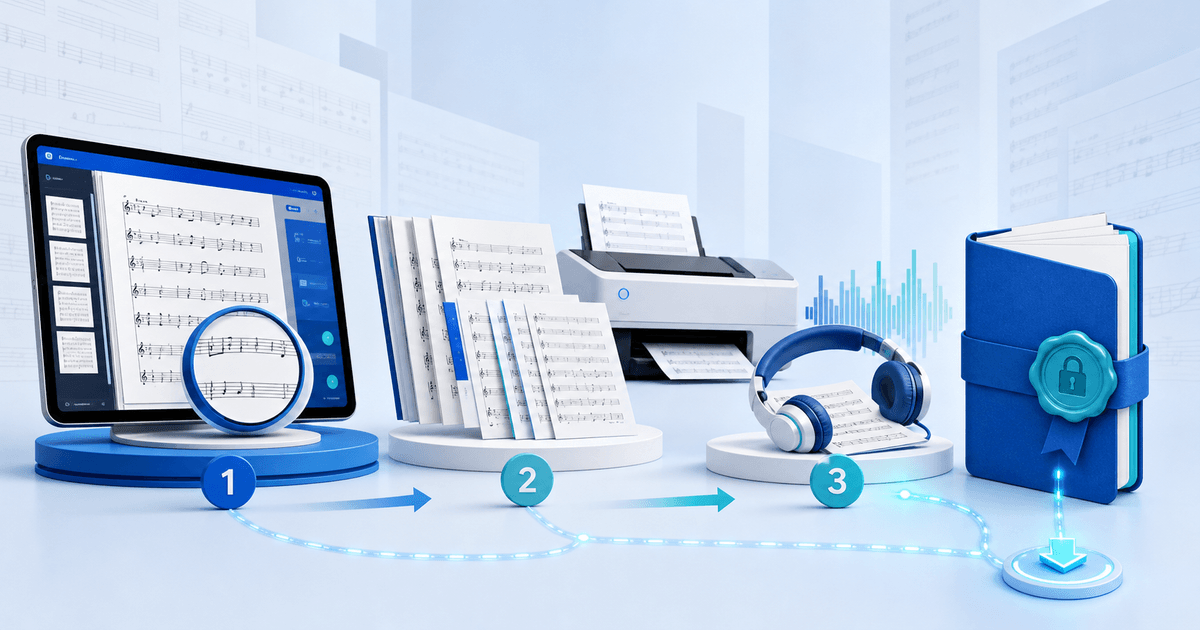
Pass 1 — screen and print. Open the retail PDF on a second device, print at 100% on the advertised paper size and inspect every page. Check embedded fonts, staff lines, margins, grayscale contrast, blank pages and page numbers.
Pass 2 — part desk. Put extracted parts in order as a player would receive them. Mark impossible or disruptive page turns, missing cues, inconsistent rehearsal marks, multi-measure rests and transposition errors. Confirm that score and parts use the same version.
Pass 3 — listening reference. Play, rehearse or render the complete work while following the exported PDF. A MIDI reference can reveal missing repeats and mismatched bar counts, but label it as a reference rather than a human performance.
Record tester, device or printer, date, result and correction for every pass. Do not claim that an ensemble performed the work unless that actually happened.
Package the Buyer Edition
Put the full score, all promised parts, license or permitted-use note, version history and optional reference audio in one ZIP. Give files sortable names such as `01-full-score.pdf`, `02-flute-1.pdf` and `reference-v1.0.mp3`. Add a one-page contents file so a buyer can spot an incomplete extraction without opening every part.
The product preview can show the cover, instrumentation, two representative pages and a short labeled audio reference. Do not publish the entire paid score as the preview or imply that a synthesized mock-up proves playability.
Deliver the Tested Edition After Payment
PayRequest can host the product page, collect payment through a connected provider and automatically release the approved archive. Use the PDF digital-download page for the score and file delivery to keep the paid order attached to the version the buyer received.
Complete a fresh order, download on phone and desktop, print the most notation-dense page and compare the archive with the release manifest. Publish when the buyer can identify the rights basis, ensemble, difficulty evidence and exact included parts before checkout.