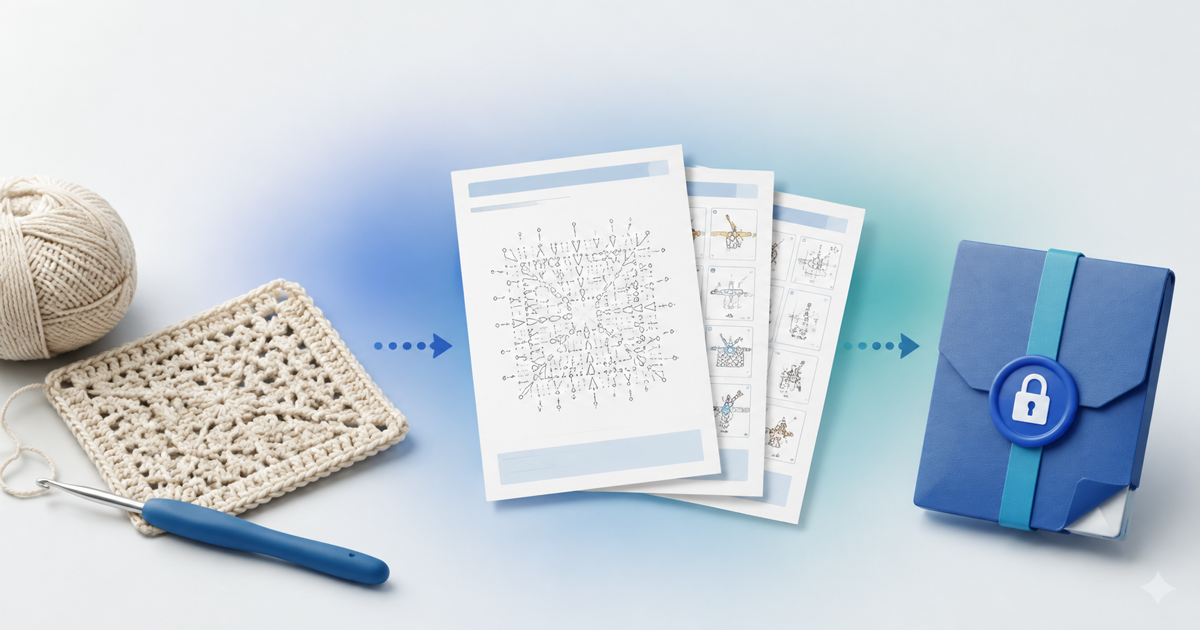
Sell a crochet-pattern PDF only after independent makers can reproduce the promised item from the buyer file. A polished cover is useful, but the real product is a repeatable set of instructions with declared terminology, yarn assumptions, gauge, sizing, photos and a correction path.
This workflow is for independent crochet designers selling original patterns directly. Its original asset is a three-maker release test: one maker follows the screen PDF, one uses a print copy and one deliberately changes yarn within the stated substitution rules.
Define the Pattern Before Designing the PDF
Freeze the tested sample, intended skill level, stitch terminology, hook size, yarn weight, gauge, finished measurements and size range. State whether terms are US or UK; the same abbreviation can otherwise point a buyer toward the wrong stitch.
The Craft Yarn Council standards provide a useful shared vocabulary for crochet abbreviations. You may need special terms, but define them beside the pattern rather than assuming every buyer uses the same shorthand.
Run a Three-Maker Release Test
| Test path | Constraint | Evidence to return |
|---|---|---|
| Screen maker | Reads on a phone or tablet | Ambiguous row, chart and navigation notes |
| Print maker | Uses ordinary A4 or Letter output | Cropped symbols, weak contrast and page-order notes |
| Substitution maker | Uses an allowed yarn alternative | Gauge, yardage and finished-size variance |
Give testers the export you intend to sell, not an editable draft. Ask them to log the page, row or round, what they expected, what happened and how they resolved it. A compliment is not a test result.
For garments or fitted items, include every advertised size in the technical review even when only selected sizes are physically made. Do not imply that one sample proves an entire graded range.
Build a Buyer-Ready PDF and Archive
Put materials, terminology, gauge, finished dimensions, skill level and construction overview before the first instruction. Number rows or rounds consistently. Place photos close to the step they clarify, add alt text when the publishing format supports it and keep essential directions in text rather than only in an image.
Export a screen-friendly PDF and test it at 200% zoom. Print it on A4 and US Letter with normal printer settings. If you promise a separate chart, low-ink copy or large-print edition, treat each as its own release artifact.
Package the final PDF with a short readme and license. The license should distinguish sharing the pattern file from selling finished items made from it. Rights depend on the work and jurisdiction, so describe your permissions clearly and obtain qualified advice for edge cases instead of copying a marketplace seller's wording.
Use a Version and Correction Ledger
Give the release a visible version such as 1.0 and keep a private ledger with version, date, affected page or row, problem, correction and buyer-notification decision. Fixing a typo in a heading is different from correcting a stitch count that changes the finished object.
For a material correction, replace the delivered file, increment the version and tell prior buyers what changed. Keep filenames stable enough to recognize but explicit enough to distinguish releases, for example `coastal-cardigan-us-v1.1.pdf`.
Rehearse the Paid Delivery
Create a PDF digital product, upload the exact tested archive and configure protected file delivery. Complete a buyer-view transaction, download on a clean device, open the PDF, follow internal navigation and compare its checksum or version with the approved release.
Do not mark an order delivered because a checkout tab returned successfully. Use the confirmed provider state, then verify that the buyer received the promised file and version.
Start with one original pattern and three structured testers. Publish when all three can identify the same materials, terminology, dimensions and next step without access to your working notes.