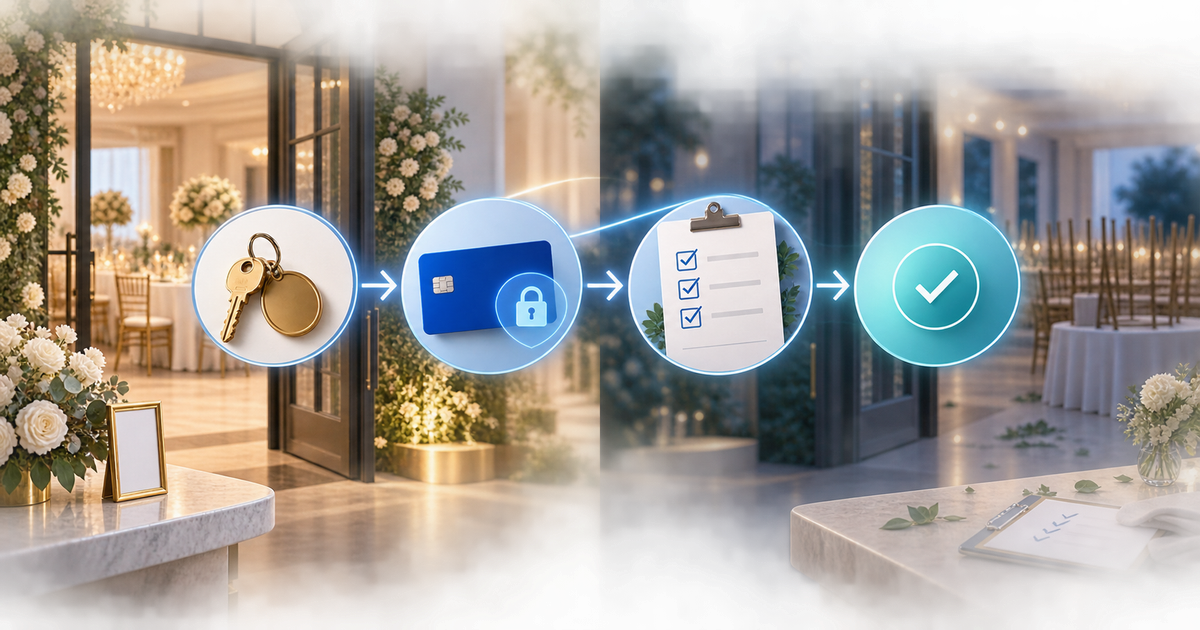
A wedding venue security deposit should be a clearly labelled, temporary protection for defined damage or incidentals—not a second name for the booking retainer. The safest operator workflow is: disclose the amount and conditions, authorize the deposit near the event, record the venue condition, inspect after departure, then release or capture only the supported amount.
This article is for independent wedding venues, barns, estates and private event spaces. It narrows the broader event-venue question to a wedding-day handover, where decor, suppliers, keys, furniture and cleanup can create evidence gaps.
Separate the retainer, balance and security deposit
| Payment | Job | Evidence to pair with it |
|---|---|---|
| Booking retainer | Reserves the date under the contract | Signed terms and cancellation rule |
| Final balance | Pays for the venue hire and agreed services | Invoice, due date and guest-count rule |
| Security deposit | Covers defined post-event damage or incidentals | Hold reference, inspection and itemized decision |
Do not describe a temporary authorization as revenue or a release as a refund. Tell the couple when the hold is expected, what can trigger a capture, who performs the inspection and how long review normally takes. Exact hold windows and eligible actions depend on the connected payment provider, card and market.
Use a wedding-day evidence chain
The useful original artifact is a paired condition record. Give the booking a venue ID and attach the same record to both handovers:
- Before access: photograph rooms, floors, walls, furniture, fixtures, keys and any supplied equipment.
- At handover: record the couple or coordinator, supplier access, time, guest-area restrictions and deposit reference.
- After departure: repeat the room-by-room walk, note cleaning or damage separately and retain timestamps.
- Before capture: identify the exact item, applicable term, evidence and amount; invite a review under the venue agreement.
In PayRequest, use security deposits for the supported authorization, release and capture states, and keep the inspection record in your operational booking file. A payment tool cannot decide whether a scuff is fair wear, replace a venue contract or guarantee a dispute outcome.
A decision table for release or capture
| Finding after the wedding | Payment action | Evidence still needed |
|---|---|---|
| No new issue | Release the full supported hold | Return time and inspection sign-off |
| Small documented issue | Consider an itemized partial capture | Photo, clause and reasonable calculation |
| Unclear or disputed issue | Pause for review within the provider window | Both condition records and written explanation |
| Amount exceeds the hold | Follow the contract's separate invoice route | Estimate or invoice and approval trail |
For a fictional €750 deposit, a €120 documented broken-chair charge is not a reason to capture the full €750. Apply the agreed terms and actual evidence. The example is a workflow illustration, not a recommendation for a universal deposit amount.
Run a staff test before publishing the booking flow: view the customer wording on mobile, verify the deposit is visibly separate from the venue fee, test the provider state available to your account, and confirm that release or capture is recorded against the correct booking. Review current pricing: PayRequest charges 2% per successful payment, capped at €25 per transaction; provider fees are separate.
Editorial note: AI assisted with this article and its illustrative cover. The three-payment table, paired condition record and €750/€120 example are original planning tools; no live authorization, capture or release is claimed.