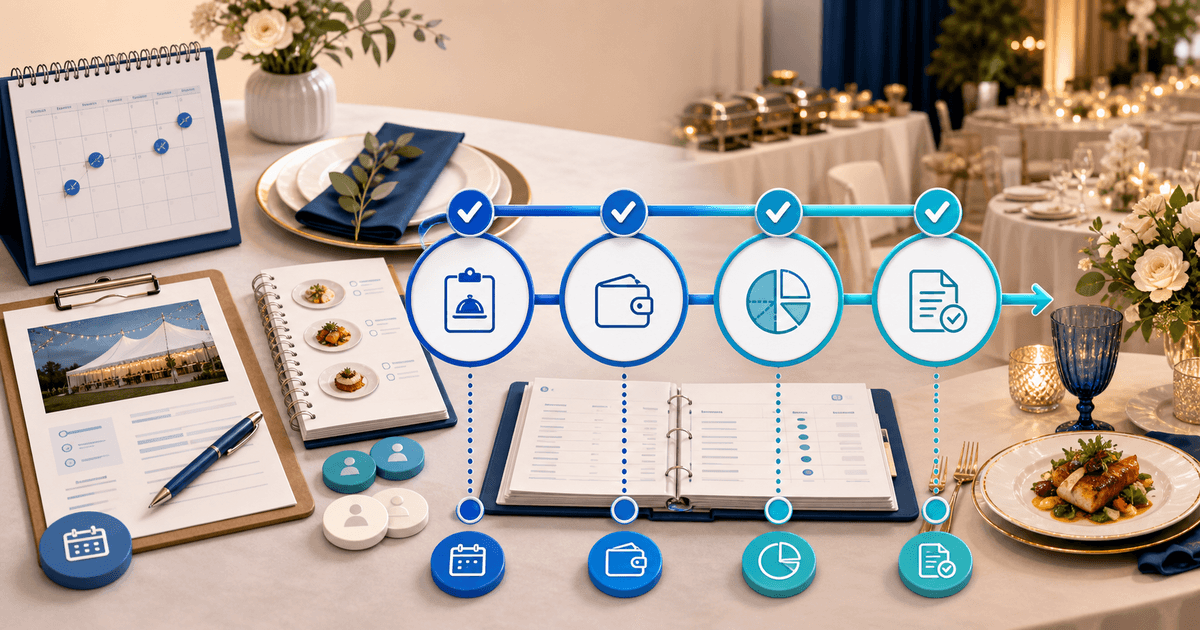
A catering payment schedule should connect money to decisions the caterer actually makes: reserving the date, approving the menu, accepting the guaranteed guest count, ordering perishables and completing service. Collecting an arbitrary percentage “because everyone does” leaves both parties unclear about what has been earned, what remains refundable and which version of the event is funded.
This workflow is for independent caterers and event-food businesses. Its original asset is a booking-to-service milestone ledger with a worked €8,400 example. It is operational guidance, not legal or tax advice; local consumer, contract and tax rules control.
Separate Four Records
| Record | What it proves | What it should not replace |
|---|---|---|
| Signed proposal or contract | Agreed scope and terms | Payment confirmation |
| Payment schedule | Amounts and due dates | Menu and guest-count change log |
| Provider transaction | Authenticated payment state | An emailed screenshot |
| Event ledger | Current scope, payments and balance | Accounting and tax records |
A booking is confirmed only when the conditions stated in the agreement are met. Name those conditions precisely—for example, signed proposal plus confirmed first payment—instead of treating a sent link or pending bank status as money received.
Build the Schedule From Cost Commitments
Worked example: an €8,400 private event has a provisional 120-person scope. The caterer maps €1,400 of planning and date-reservation exposure, €2,000 of equipment and supplier commitments, €3,800 of food and staffing commitments near the final count, and €1,200 retained for service completion and approved extras.
| Milestone | Example amount | Operational gate |
|---|---|---|
| Contract and date confirmation | €1,400 | Date leaves provisional hold |
| Menu approval / supplier booking | €2,000 | Rentals and special orders released |
| Guaranteed count deadline | €3,800 | Final purchasing and rota authorized |
| Service / approved extras | €1,200 | Final invoice reconciled |
These are transparent assumptions, not recommended universal percentages. Build amounts from your documented exposure and cash-flow needs. Keep taxes, gratuities, service charges, damage/security holds and cancellation charges distinguishable rather than calling every advance amount a deposit.
Keep Changes and Payments in One Ledger
Give each proposal version and payment request an ID. Record event date, agreed scope total, guest-count assumption, milestone, amount due, due date, provider state, paid date, change-order reference and remaining balance. Never overwrite a paid schedule when the client adds 20 guests; append an approved change and recalculate visibly.
At the guarantee deadline, freeze the billable count according to the signed agreement. If later additions are possible, state price, acceptance deadline and operational limits. A successful extra payment does not mean the kitchen can safely accept work it has not approved.
Treat Cancellation Terms as a Separate Decision
Do not describe every payment as automatically non-refundable. In the UK, current government guidance on fair customer contracts says retained prepayments and cancellation charges should reflect genuine direct loss and steps the business can take to reduce it. Other jurisdictions differ; have local terms reviewed and explain the calculation before checkout.
When an event changes or cancels, record committed costs, recoverable supplier credits, work already delivered and any replacement booking. Issue the agreed refund, credit or balance as a separate transaction. This prevents the payment ledger from becoming a retroactive justification.
Collect Each Approved Milestone
Use PayRequest invoicing for a named customer, scope and due date, or bookings when the paid event slot is the core workflow. Connect an eligible payment provider and verify settlement in the authenticated dashboard rather than accepting screenshots.
Before sending the next request, reconcile: agreed total plus approved changes, minus confirmed payments and credits, equals remaining balance. Complete a test from proposal through payment confirmation and reminder handling. The process is ready when staff can explain every euro, scope version and due date without reconstructing the event from email.