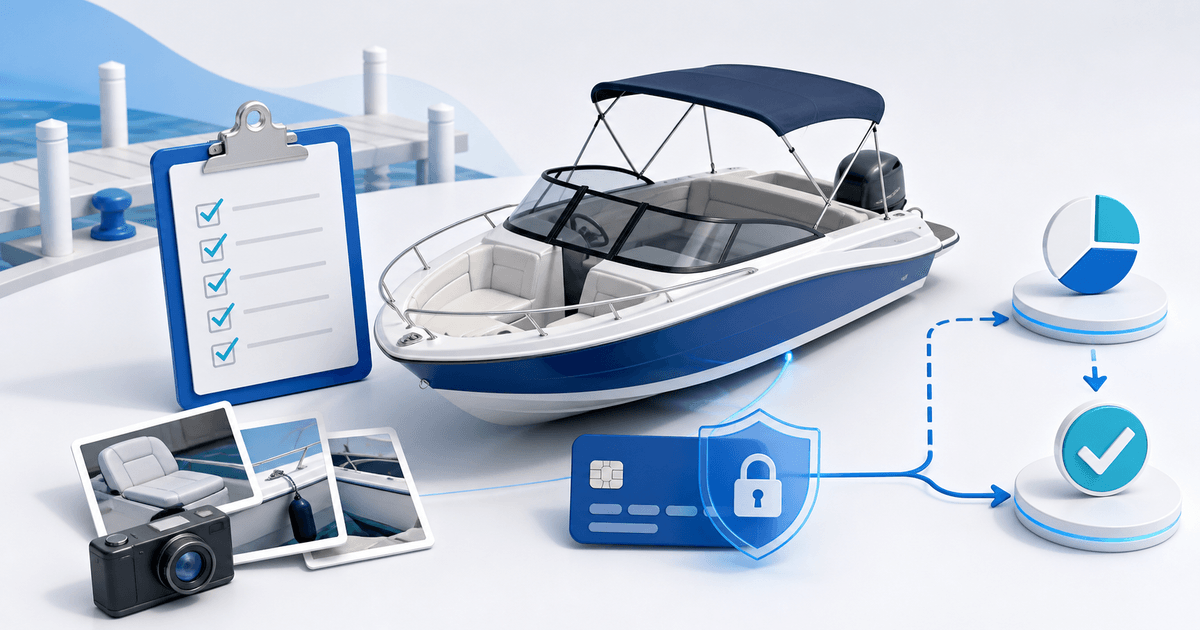
Boat security deposits protect a rental or charter operator against agreed damage, missing equipment and other supported costs. A card pre-authorization reserves the customer's funds; a collected deposit takes money and requires a refund of any unused balance. Choose the method before booking, explain it clearly, and match the authorization deadline to the return inspection.
This guide is for independent boat, RIB, jet-ski and yacht-charter operators. It includes a departure record, a timing calculation and a worked settlement. The amounts are examples, not market averages or recommended legal limits.
Separate the booking payment, damage deposit and insurance
| Item | Purpose | What happens to the money |
|---|---|---|
| Booking payment | Reserves the charter date | Charged and handled under cancellation terms |
| Charter balance | Pays for the trip | Charged as the agreed rental price |
| Security-deposit card hold | Reserves funds for supported claims | Released or captured before expiry |
| Collected refundable deposit | Provides security through a payment | Unused money must be refunded |
| Damage waiver or insurance | Changes specified risks under its own terms | A fee or premium is not automatically refundable |
A damage waiver does not necessarily remove the security deposit. Read the exclusions, excess and claim procedure together. Do not tell customers that a card hold is insurance or that the hold amount always caps their contractual liability.
How much should a boat security deposit be?
Build the amount from the particular vessel and agreement. Review the insurance excess, outboard and propeller exposure, inventory, agreed fuel policy and the customer's available card limit. Disclose the amount and currency before confirmation. Copying another marina's amount is not a risk assessment.
Use a worksheet with four columns: covered event, agreement clause, evidence required and cost basis. For a missing fender, record its inventory identifier and replacement basis. For fuel, record the departure and return measurements and agreed rate. Keep normal wear and pre-existing damage out of new damage calculations.
Ask your insurer how a deposit and any deductible interact. Local consumer rules and the agreement determine what can be charged; possession of a card authorization does not establish the customer's liability.
Can a card hold cover a seven-day yacht charter?
Only if the actual authorization remains valid until the required capture decision. The planning interval includes time before departure, the charter itself and inspection after return. A seven-day trip with authorization one day before departure and inspection the next day needs a nine-day interval, before any operational buffer.
Stripe documents different authorization windows, depending on card and transaction type. Its extended-authorization option is conditional. PayRequest requests an extension when available in its Stripe flow; that request is not a promise that the extension was granted. Use the actual deadline shown for the authorized deposit.
| Illustrative booking | Time from authorization to inspection | Planning decision |
|---|---|---|
| Same-day boat hire | Morning to late afternoon | Verify confirmed funds and today's inspection staffing |
| Three-day RIB hire | Day before departure through return afternoon | Compare the full interval with the actual deadline |
| Seven-day charter | One day before plus seven days plus one day after | Do not assume a standard hold covers nine days |
| Longer charter | Beyond the granted authorization window | Agree a supported alternative before departure |
If the deadline is too short, arrange an eligible alternative with the customer and provider. Do not assume an expired hold can be renewed silently or capture an unsupported amount merely to preserve funds. The expired-authorization guide covers that failure state.
Copy this departure and return record
Use the same checklist twice, with comparable photographs. Keep the evidence in your own booking records; creating a PayRequest link does not automatically perform a marine survey or store this checklist.
- Booking reference, vessel identifier, renter and staff member.
- Departure time, return deadline and inspection appointment, including timezone.
- Hull zones, propeller, skeg, upholstery and existing marks.
- Fuel reading, engine hours and agreed fuel return condition.
- Keys, fenders, electronics and inventory counts.
- Safety equipment check under your operating procedures.
- Dated photos and customer acknowledgment of the condition record.
- Deposit reference, confirmed authorization and capture deadline.
Name one staff member responsible for checking the returned vessel and one backup. A weekend return without inspection cover is a payment-process problem as well as an operations problem.
A worked €1,000 boat-deposit settlement
Suppose the authorized hold is €1,000. After return, the agreement and records support €120 for a missing item and €80 for fuel. These illustrative costs total €200. In PayRequest's current Stripe flow, the final partial capture charges €200 and releases €800. The €800 is no longer available for another capture.
Finish the inspection and calculate the whole supported amount before confirming. Send the renter an itemized explanation with the relevant agreement clause and evidence. Distinguish estimated repair costs from a completed invoice and avoid treating the deposit as an automatic penalty.
If no supported claim exists, release the hold. A release is not a refund of a settled payment; the customer's bank controls when the available balance visibly updates. Read the partial-capture walkthrough before settling the first booking.
Manage boat security deposits in PayRequest
Connect your supported provider and create a security-deposit link. Include a recognizable booking reference. Send it at the agreed time and confirm Authorized or Funds reserved before relying on it. Pending or Waiting for customer is not a confirmed hold.
Open Security Deposits, then the customer name or View Deposit. Check the deadline, release the hold if appropriate, or select Partial Capture when available and review the charged and released amounts before the final confirmation. PayRequest's current Stripe capture is final; it does not leave the unused balance open for a second capture.
Free currently includes 1 active deposit and 3 new deposits per month. Check your dashboard allowance and the current deposit plan conditions before planning a fleet rollout. The current Stripe deposit-capture flow has €0 PayRequest platform fee; Stripe processing fees and any subscription remain separate.
Use the security-deposit feature overview to set up the workflow. If you also rent shore-side event equipment, the refundable hire bond guide explains the wording and settlement record for that business.
Editorial note: updated 13 September 2026 with PayRequest application-code checks and provider documentation. AI assisted with writing. The worksheet and amounts are original illustrative examples; no live payment or customer outcome is claimed.