To price a product photography package, count the finished images, cost all the work needed to produce them, then agree what the client can buy for that price. Eight products with three views each are 24 deliverables, not eight photos. A fixed package only protects your time when angles, retouching, revisions and usage are defined before payment.
This worked example is for an independent photographer selling commercial product images. All quantities, hours and euro rates below are hypothetical planning inputs, not market averages, an actual quote or customer results. Download the editable cost worksheet and replace them with your own costs.
Start with the shot list, not a headline price
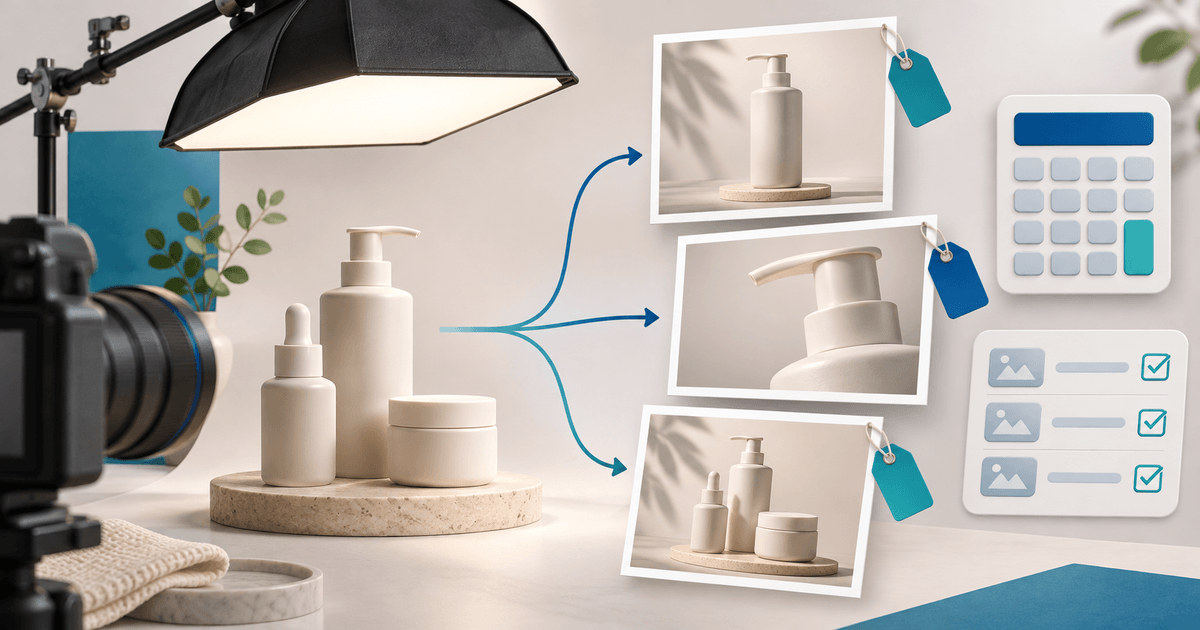
Assume a small skincare brand sends eight opaque bottles for a white-background catalogue shoot. It wants a front view, back view and detail of every bottle. There are no models, reflective glass, styled scenes, moving images or complex composites in this example.
| Deliverable | Calculation | Finished images |
|---|---|---|
| Front view | 8 products × 1 view | 8 |
| Back view | 8 products × 1 view | 8 |
| Label/detail view | 8 products × 1 view | 8 |
| Total | 8 products × 3 views | 24 |
Give every product a SKU or other stable identifier and every angle a name. A useful filename is `SKU-01_front_v1.jpg`. The shot list connects the client's brief, your proof gallery and final delivery. It prevents “one more angle” from becoming an invisible addition to the package.
This unit matters in real offers: ProductPhoto.com's pricing page defines a photo as one final image of one product from one angle. Its published offer also separates work needing special handling. That is one studio's commercial model, not a universal rate card. Your own quote should say what counts as a deliverable.
Calculate the cost of the entire batch
Assume your internal labour cost is €40 per hour. This is a planning allowance for your time, not an employee wage recommendation or a promise about take-home income. The example includes paid work that happens away from the camera.
| Work or expense | Input | Cost |
|---|---|---|
| Brief, intake and product check | 1 hour × €40 | €40 |
| Styling and lighting setup | 1.5 hours × €40 | €60 |
| Photography | 3 hours × €40 | €120 |
| Retouching | 2 hours × €40 | €80 |
| Proofs, exports and client administration | 1.5 hours × €40 | €60 |
| Studio/equipment allocation | Assumed batch allowance | €60 |
| Materials and consumables | Assumed batch allowance | €20 |
| Total cost allowance | 9 labour hours + €80 | €440 |
Replace the equipment allowance with your real allocation and include insurance, software, assistance, shipping and other overhead where applicable. Do not count the same cost twice. If return shipping is extra, state who pays and how it is approved. ProductPhoto.com's FAQ is a useful primary example of a ship-in studio making the product handoff explicit; your own arrangements may differ.
Now choose an illustrative 20% margin before checkout fees and tax. The package price is:
The €110 difference is 20% of the selling price. Multiplying €440 by 1.20 would produce €528, which is a 20% markup on cost, not a 20% margin on sales. Neither number tells you what your local market will accept. Compare the scope with actual buyer expectations and decide whether the job is commercially viable before advertising it.
Explain what €550 buys
The average is €550 ÷ 24 = approximately €22.92 per finished image. Keep €550 as the agreed batch price; rounding an average and multiplying it back can change the total.
For this fictional offer, the client receives 24 final JPEGs at the agreed dimensions, on one agreed background, with dust cleanup and basic colour/exposure consistency. Define the export requirements before shooting. State whether transparent backgrounds, clipping paths, layered files or raw captures are excluded.
Include one consolidated feedback round against the approved brief. Separate correction of an error in your delivery from a new creative direction or replacement product. State the usage permission, any third-party asset restrictions and whether your own portfolio use needs consent. Do not treat payment as agreement to rights the client has never seen.
Confirm how products arrive, who checks damage, when the delivery clock starts, when proofs are reviewed and how goods are returned. Avoid an unconditional turnaround promise before usable products and the brief are received.
Price a change before you shoot it
Suppose the client asks for two additional views of three products: six new images. Assume an extra hour of photography, 45 minutes of retouching and 15 minutes of coordination, plus €20 of setup costs.
The extra cost allowance is 2 hours × €40 + €20 = €100. At the same illustrative pre-fee margin, the change price is €100 ÷ 0.80 = €125. The revised order is €675 for 30 images. Send the revised shot list, fee and deadline for written approval before doing the extra work.
A replacement label arriving after approval may require a reshoot rather than a simple export. A new lifestyle scene has different setup costs. Do not automatically apply the average €22.92 image price to every change.
Turn the agreed package into a paid service
With PayRequest service selling, create a service offer that states the deliverables, intake requirements and delivery process. Use the approved shot list as the scope reference. For custom requests, settle the scope before sending the agreed amount through a payment link; keep written approval and production files in your chosen project channel.
For illustration, a 40% advance on the original €550 package is €220 and the remaining amount is €330. If the €125 change is approved and payable with the balance, the final collection is €455. Total receipts should reconcile to €220 + €455 = €675. This is a manually agreed collection schedule, not a claim that PayRequest automatically manages a photography project, proof gallery or staged contract.
Connect a payment provider eligible for your business and country. Start work or release files at the agreed payment stage after confirmed payment, not a screenshot or pending checkout. Publish cancellation, refund and product-return terms suitable for your business and applicable requirements.
On Free, standard payments have a 2% PayRequest fee capped at €25 per transaction. In the €675 example collected as €220 and €455, that is €4.40 + €9.10 = €13.50. The €135 difference between the revised price and €540 cost allowance becomes €121.50 before provider fees and tax: an 18% margin at that stage, not the original 20%. Budget the remaining costs before relying on that number.
Active Premium (€5/month) and Business (€20/month) remove standard platform fees; provider fees and commission-payment exceptions remain separate. Check current plans for features. Signup alone does not activate paid access.
Editorial note: AI assisted with the draft and illustrative cover. The batch, prices and payment stages are hypothetical; the arithmetic was checked. No photography shoot, payment or customer outcome was tested. Sources and product pages reviewed on 12 November 2026.