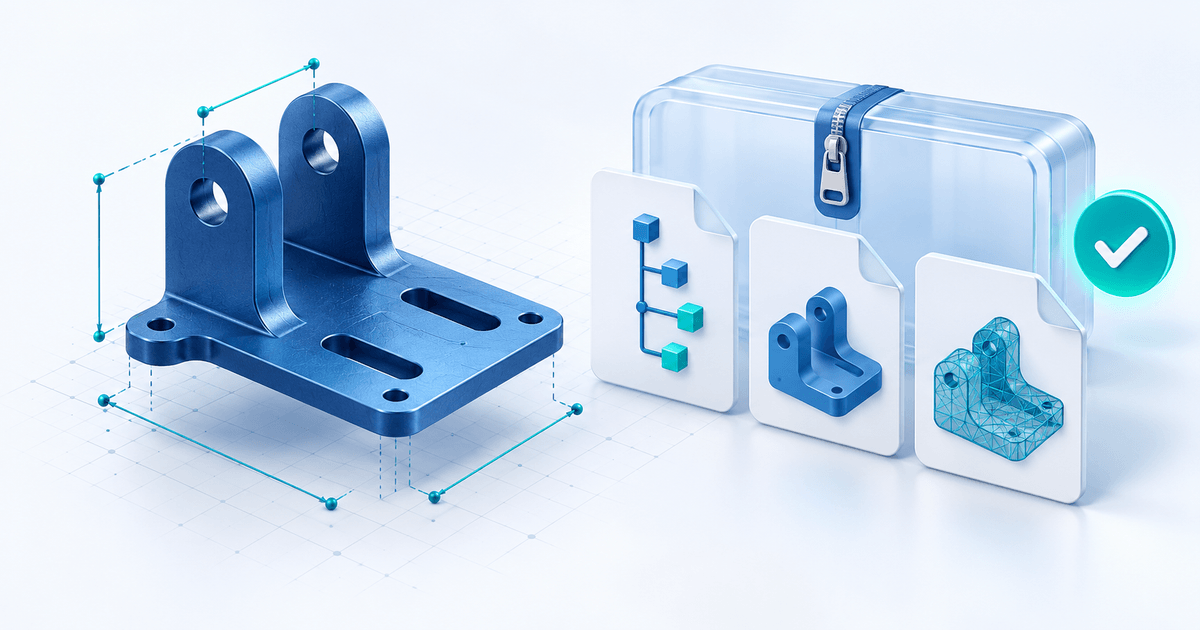
STL is still the most recognizable file extension in desktop 3D printing, but it was never designed to carry a complete modern print project. It mainly describes a model's surface as triangles. A 3MF document can package geometry with defined units, multiple objects, colors, materials, thumbnails, metadata, and supported extensions.
That makes 3MF the stronger working and delivery format when your slicer, printer, and buyer support it. It does not make STL useless. STL remains a practical compatibility export because almost every 3D-printing workflow can open it.
Key Takeaways
- 3MF is an open, royalty-free format designed for additive manufacturing
- It became the ISO/IEC 25422:2025 international standard
- 3MF stores explicit units and can package multiple objects, materials, colors, textures, thumbnails, and metadata
- STL normally carries triangulated surface geometry and does not define the model's unit
- 3MF uses a ZIP-based package and is often smaller for complex projects
- Many sellers should deliver 3MF first and STL as a compatibility fallback
What Is an STL File?
STL represents the outer surface of a three-dimensional object with triangles. Its simplicity explains its longevity: CAD software exports it, slicers read it, and marketplaces recognize it.
A basic STL does not reliably tell the receiving application whether a dimension means millimeters or inches. It also does not natively preserve color, material assignments, thumbnails, named parts, or print settings as one structured project. It can still be exactly what a buyer needs for a single-color model they want to orient and slice themselves.
What Is a 3MF File?
3MF stands for 3D Manufacturing Format. The 3MF Consortium designed it to transfer full-fidelity models between design applications, platforms, services, and printers.
A .3mf file is a ZIP-based Open Packaging Conventions package. The core specification defines geometry, components, units, thumbnails, document properties, metadata, and optional digital signatures. Extensions add richer materials, production data, beam lattices, slices, and protected content.
The specification is open and royalty-free. In 2025 it was recognized as ISO/IEC 25422:2025.
3MF vs STL Compared
| Capability | 3MF | STL |
|---|---|---|
| Surface geometry | Yes | Yes |
| Explicit measurement units | Yes | No standard unit field |
| Multiple objects/components | Structured in one document | Usually separate or combined meshes |
| Color and material data | Supported | Not in the standard |
| Textures and thumbnails | Supported | No |
| Metadata and license fields | Supported | No |
| Compression | ZIP-based package | No package compression |
| Extensibility | Namespaced extensions | No standard extension system |
| Legacy compatibility | Growing | Excellent |
Why 3MF Is Better for Modern Printing
The model declares its unit, including millimeter, inch, and other supported values. That reduces the common failure where software opens a mesh at the wrong scale.
A product can contain bodies, inserts, supports, color-separated pieces, or a complete plate. 3MF can keep multiple objects and transforms in one structured document.
The specification supports base materials, colors, textures, and advanced properties through extensions. Application support varies, but the format has a standard place for the information. STL does not.
3MF's ZIP packaging can reduce transfer sizes for complex geometry. It can also carry title, designer, description, copyright, license terms, creation date, and thumbnails.
When STL Is Still Right
Choose STL when maximum compatibility matters more than project context. Older slicers, marketplace validators, and specialized utilities may only accept STL. It is also adequate for a simple single-part model when the scale and instructions are documented separately.
A strong commercial bundle can include:
- The 3MF project as the recommended version
- STL exports for broad compatibility
- STEP when editable neutral CAD is part of the offer
- A README with scale, orientation, materials, tolerances, and tested settings
- Preview images and a clear license
Not Every 3MF Is Equally Portable
Applications can store vendor-specific data or extensions another application does not understand. A slicer project may include profiles for a particular printer, nozzle, filament, or plate.
Reopen the final file in every software version named on your product page. Clearly distinguish portable model data from slicer-specific settings, and include neutral STL exports.
Final Verdict
3MF is the better format for preserving design intent. It solves important STL weaknesses: ambiguous units, missing metadata, limited material information, and fragmented multi-part projects.
STL is not disappearing overnight. The practical 2026 answer is “3MF first, STL fallback” whenever your tools and customers support both.