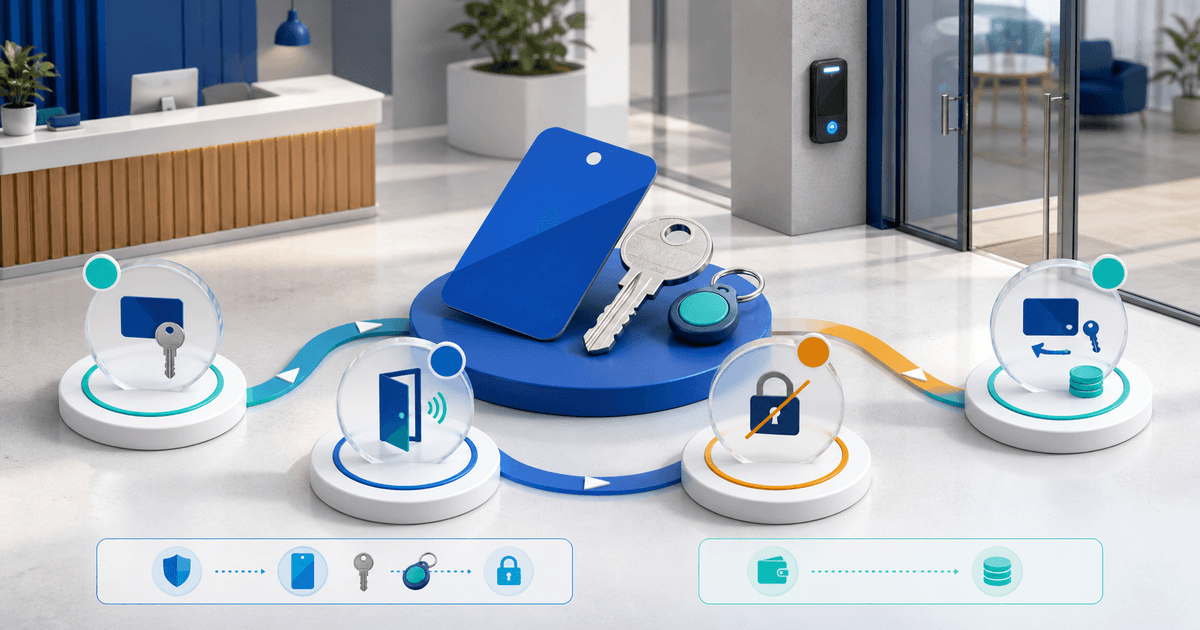
A coworking keycard deposit should connect one member, one access credential and one financial state from issue to deactivation and return. Do not use a payment record as the access log: it cannot prove which card was issued, whether it was blocked after loss or whether the returned key belongs to the same suite.
This workflow is for independent coworking spaces that issue cards, fobs, keys or parking credentials. Its original asset is an issue-to-return custody ledger that keeps building security decisions separate from release or supported capture of a deposit.
Separate Three Decisions
Access permission decides where and when a member may enter. Credential custody records the physical card, fob or key. The deposit authorization provides a disclosed financial route for defined exceptions. A membership ending does not by itself prove that every credential was returned, and a lost card should be deactivated without waiting for a deposit decision.
Show the deposit amount, likely hold period, replacement basis, return deadline and contact route before authorization. Card-network timing, provider rules and local consumer or tenancy law can differ; adapt the agreement to the actual space.
Use an Issue-to-Return Ledger
| Stage | Record | Required state |
|---|---|---|
| Authorization | Member, agreement, amount, provider status and expiry | Valid before handover |
| Issue | Card/fob serial, key code, access zones, issue time and staff member | Active and acknowledged |
| Change | Added zone, replacement, temporary loan or reassignment | Old and new states preserved |
| Incident | Lost time, report channel, immediate deactivation and replacement decision | Security response logged first |
| Return | Credential identity, return time, physical state and access revocation | Matched to issue record |
| Finance | Release, supported partial capture or another permitted route | Reason and evidence attached |
Never store door PINs, encryption keys or information that would help someone clone a credential in the customer-facing record. Store only the identifier needed to reconcile custody with the access-control system.
Respond to a Lost Card in the Right Order
First record the report and disable the credential. Then check recent access events according to your security and privacy policy. Issue a temporary or replacement credential only after confirming identity and documenting what happens to the old one.
A current coworking house-rule example from The Social Hub Amsterdam instructs members to report a lost access key immediately so it can be blocked. That illustrates the operational priority; it does not establish a universal fee or deposit rule.
Inspect the Return Without Inventing Damage
Match the printed or system identifier, record return time, confirm deactivation and inspect only observable condition. A scratched card that still belongs to the correct member is different from a missing master key or a fob that cannot be identified.
If the displayed terms permit a replacement cost, use an itemized basis: replacement device, locksmith or re-key work actually required, and documented administration where lawful. Do not turn the full authorization into an automatic penalty. Preserve the original agreement, issue record, incident log, supplier evidence and member communication.
Connect Custody to the Deposit
Use PayRequest's coworking security-deposit workflow to connect the member, authorization, release and supported capture. The security-deposit overview explains why a pre-authorization is a temporary hold rather than an immediate charge.
Before launch, rehearse four cases: correct return, a lost card reported promptly, an unidentifiable key and a credential reassigned to another member. A second staff member should be able to reconstruct access, custody and money states without relying on memory.