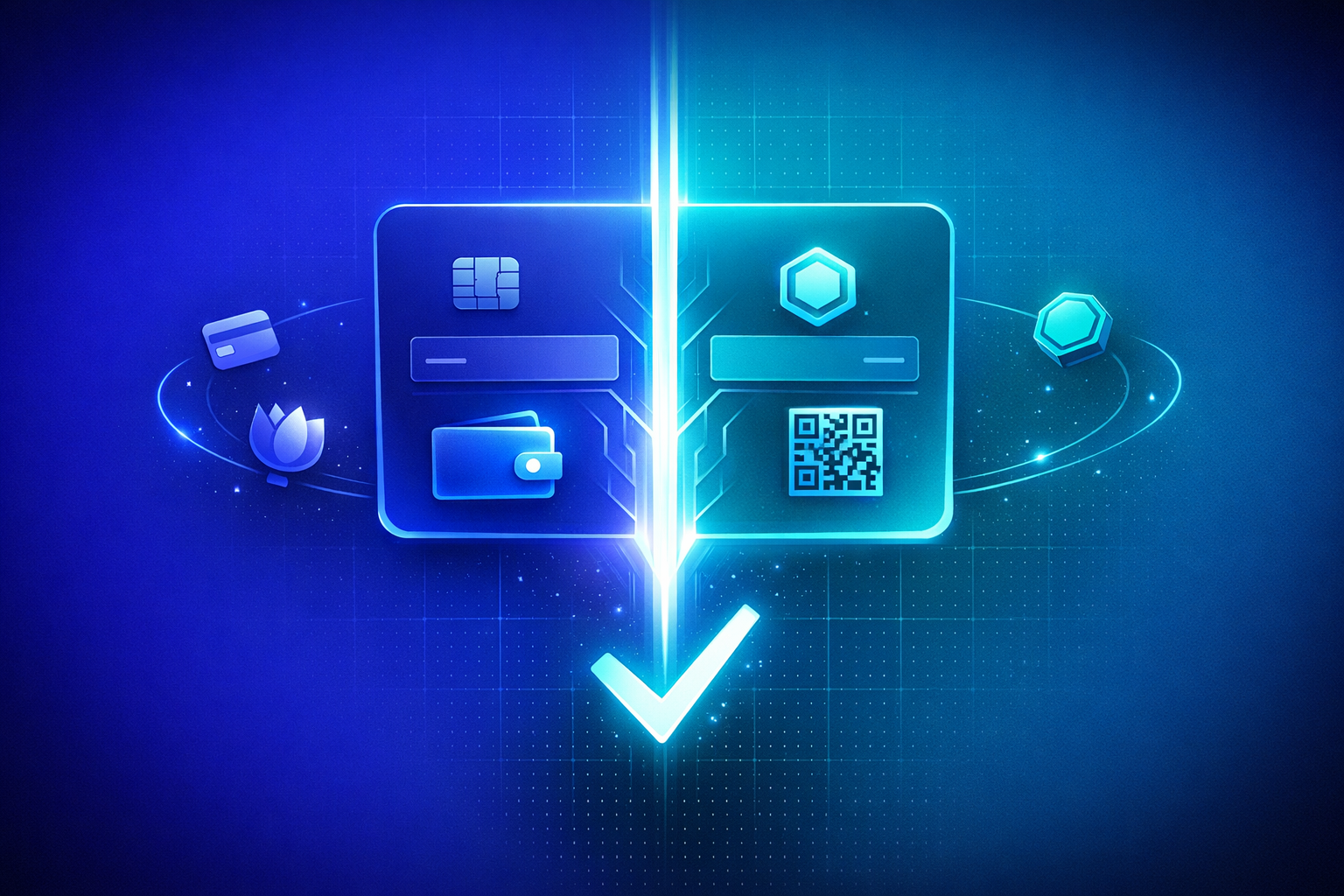
Should you accept crypto payments, fiat payments, or both? In 2026, the answer for most businesses is clear: both.
Crypto-native customers increasingly expect to pay with USDC from their MetaMask or Coinbase Wallet. Traditional customers prefer cards, iDEAL, or PayPal. Offering only one means losing the other group.
This guide explains why accepting both crypto and fiat is simpler than you think, how PayRequest combines them on a single checkout page, and which businesses benefit most from a dual-payment strategy.
Why Offer Both Crypto and Fiat?
The old assumption was that accepting crypto meant going all-in — running your own node, integrating smart contracts, managing wallet infrastructure. And accepting fiat meant choosing a processor like Stripe or PayPal and integrating separately.
In 2026, these worlds have converged. PayRequest lets you connect Stripe, Mollie, PayPal, and WalletConnect (for USDC on Base) to the same dashboard. Every payment link offers all methods. The customer picks what they prefer; you see everything in one place.
| Customer Type | Preferred Method | Why |
|---|---|---|
| European consumer | iDEAL (NL), Bancontact (BE), SEPA | Trusted local methods, no card needed |
| International consumer | Credit/debit card | Universal, widely understood |
| US customer | Card or PayPal | Familiar, buyer protection |
| Web3 native | USDC via MetaMask/Coinbase Wallet | Non-custodial, no bank needed |
| High-risk industry | USDC via WalletConnect | Zero chargebacks |
| International B2B | USDC on Base | Cheaper than SWIFT, instant settlement |
The groups overlap. A crypto-native freelancer in Berlin might pay business expenses with a card but prefer USDC for client invoices. A SaaS company might accept cards from most customers but add USDC for international users who face card-decline issues.
Running Stripe for cards and a separate crypto payment processor means:
- Two logins, two reconciliation workflows
- Customers cannot choose between methods on a single checkout
- Higher operational overhead for your finance team
With PayRequest, one dashboard shows all transactions regardless of payment method. Customers see all options on one checkout page. Reporting, reconciliation, and analytics cover both fiat and crypto in the same view.
How PayRequest Handles Crypto + Fiat
When you create a payment link in PayRequest, the checkout page automatically displays all payment methods you have connected. The customer sees:
| USD €149.00 |
|---|
| 💳 Credit Card (Stripe) |
| 💳 iDEAL (Mollie) |
| 💳 Bancontact (Mollie) |
| 💳 SEPA Direct Debit (Mollie) |
| 💳 PayPal |
| $ USDC on Base (WalletConnect) |
They pick whichever method works for them. Crypto-native customers choose USDC and scan a WalletConnect QR. Traditional customers pick cards or iDEAL. Everyone completes the same checkout flow.
- Fiat payments (Stripe, Mollie, PayPal): processed normally, funds settle to your connected merchant accounts
- Crypto payments (USDC on Base): the customer signs a transaction in their wallet, the USDC is forwarded to your connected wallet (minus PayRequest's 2% capped at €25), and the funds arrive in under 2 seconds
- Reconciliation: all transactions appear in your PayRequest dashboard — payment method, amount, status, customer — regardless of whether the customer paid with a card, iDEAL, or USDC
PayRequest charges a single fee structure regardless of payment method:
- 2% per successful payment, capped at €25 per transaction
- No monthly fee — all features included on the free plan
- No setup cost — no integration fees, no smart contract deployment
Provider processing fees apply on top:
- Cards (Stripe): 1.5% + €0.25 (EU) / 2.9% + €0.25 (non-EU)
- iDEAL (Mollie): €0.29 flat
- SEPA (Mollie): €0.25 per direct debit
- PayPal: 2.9% + €0.35
- USDC (Base): <€0.01 network gas (paid by customer wallet)
Who Benefits Most from Dual Payments
If you invoice clients in different countries, you face a dilemma: US clients expect PayPal, EU clients prefer SEPA or iDEAL, and international clients may prefer USDC to avoid SWIFT fees. With PayRequest, one invoice link offers all options. Your client picks; you get paid.
SaaS businesses often have a mix of consumer and business customers across multiple countries. Cards work for most, but conversion drops when card payments fail due to regional restrictions (common in Latin America, Southeast Asia, and Africa). Adding USDC as a fallback recovers revenue from customers whose cards are declined.
Selling templates, courses, ebooks, or software? Your customers include both mainstream buyers (cards, PayPal) and crypto-native users (USDC). Offering both means no sale is lost because the customer's preferred method is missing.
An online store that only accepts credit cards misses customers who prefer PayPal, iDEAL, or crypto. A dual-payment strategy captures every customer segment and maximizes conversion at checkout.
Getting Started
Adding both crypto and fiat to your payment stack takes under 10 minutes with PayRequest:
- Sign up at payrequest.app/register (free, no credit card)
- Connect providers: Stripe (cards), Mollie (iDEAL/SEPA), PayPal, and WalletConnect (USDC) — each takes about 3 minutes via OAuth
- Create your first payment link — it automatically offers all connected methods
- Share the link — your customers see crypto and fiat options on the same page
No code. No smart contracts. No separate platforms.
Already using PayRequest? Connect WalletConnect in your Payment Providers settings to add USDC alongside your existing fiat methods.