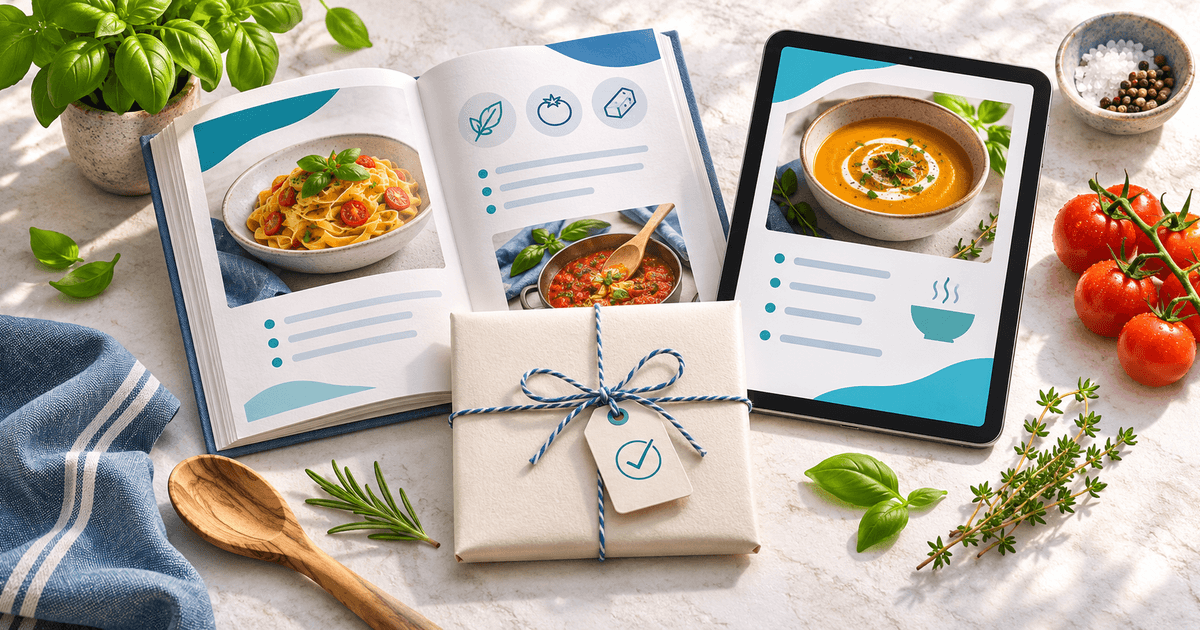
To sell a digital cookbook online, choose a clear cooking need, test and document your recipes, create readable digital files and show a representative sample before payment. Sell the finished book as a download with a clear edition, contents list and support route.
This guide is for recipe creators who already share useful cooking content and want to package their own work into a paid book. It covers the publishing and selling workflow, not food-safety certification or nutrition advice.
Choose a reason to buy the collection
A hypothetical “ten weeknight tray dinners for two” is easier to evaluate than “my best recipes.” The buyer can understand the meal type, portion context and likely use. Do not label the book suitable for a medical diet or promise savings without evidence supporting that claim.
Give readers a complete sample recipe, an honest contents list and photographs that represent the food. A preview should answer whether they have the skills, equipment and ingredients the book assumes. Keep any retailer or ingredient-brand references factual and avoid implying sponsorship.
Use one recipe production card
Download the editable recipe production card. Use it once per recipe and keep the records outside the retail book if they contain private reviewer details.
| Field | What to record | Publishing decision |
|---|---|---|
| Recipe and edition | Title, revision date and file | Which version was checked? |
| Yield | Portions and portion assumptions | Will buyers understand quantities? |
| Ingredients | Exact amounts, preparation and units | Can someone shop from the list? |
| Equipment | Pan sizes and essential tools | Are hidden dependencies disclosed? |
| Method | Ordered actions and observable cues | Does the sequence match the ingredients? |
| Timing | Active time and total elapsed time | Are resting and preheating included? |
| Review | What was tested, by whom and remaining issues | Is it ready to publish? |
| Credits | Photos, illustrations and other sources | Do you have the required permissions? |
The card is an editorial checklist, not evidence that a recipe is safe. Any food-safety directions should follow authoritative guidance relevant to the food and audience; do not invent storage periods to fill a template.
Work through a small book before designing a large one
For the hypothetical ten-recipe offer, create ten completed recipe cards and one contents page. Check that every ingredient appears in the method, units are consistent and the yield is clear. Ask a reviewer to follow a recipe from the exported book without your help and record ambiguities.
If you include alternate ingredients, explain whether you tested them. Do not present a guessed substitution as a proven equivalent. Separate active preparation from total elapsed time so a recipe with a long rest is not marketed as a quick dinner.
Use your own wording and images or material you have permission to publish. Check the relevant rights before reusing another creator's recipe prose, photographs or illustrations. Avoid making broad legal claims about what “a recipe” protects across countries.
Choose the reading format deliberately
PDF works well for fixed recipe layouts and print editions. A mobile reading edition should remain usable without constant zooming; it may need a simpler layout than a print spread. EPUB can be appropriate when reflowable text is more important than exact page positioning.
If you sell EPUB, validate it using W3C's EPUBCheck and then inspect navigation and images in the readers you advertise. Validation does not replace trying to follow a recipe on the actual device. See our EPUB selling guide for the handoff to reading apps.
If you only supply PDF, say so. A PDF download is not a printed book, a cooking course or automatic delivery to a Kindle library. Give files clear names and include a short guide when several editions are bundled.
Price the offer with explicit assumptions
Suppose you choose €12 as an illustrative one-time price. Thirty standard sales would produce €360 in gross sales. On PayRequest Free, 2% standard platform fees would be €7.20, leaving €352.80 before provider fees, tax, refunds and production costs. This example is not a sales forecast, market benchmark or take-home earnings estimate.
The Free fee is capped at €25 per transaction. Premium (€5/month) and Business (€20/month) remove standard platform fees while paid access is active; provider fees and commission exceptions remain separate. Check current pricing and the features you need. A digital cookbook can be sold on Free.
Publish a page that answers the purchase questions
List recipe count, formats, language, equipment assumptions, file size and included editions. Explain whether future corrections are included and provide a support contact. Payhip's cookbook selling page illustrates that digital and printed formats can be separate offers; make your own download terms equally explicit.
In PayRequest, create an ebook digital product, attach the final PDF or a ZIP of editions, connect a supported provider and review the purchase page. Use file delivery for the approved book after confirmed payment. Perform a buyer-view download and reading check before announcing it.
Promote the book beside a relevant free recipe, cooking video or newsletter. The free sample should demonstrate your work; the product page should explain the additional value of the complete collection. Measure clicks to the book and completed purchases rather than assuming followers equal buyers.
Editorial method: prepared with AI assistance and an original recipe production card; official documentation reviewed on 8 November 2026. The book concept, prices and sales counts are hypothetical. No recipe test, nutritional review or customer result is claimed. The cover is an AI-generated conceptual illustration.