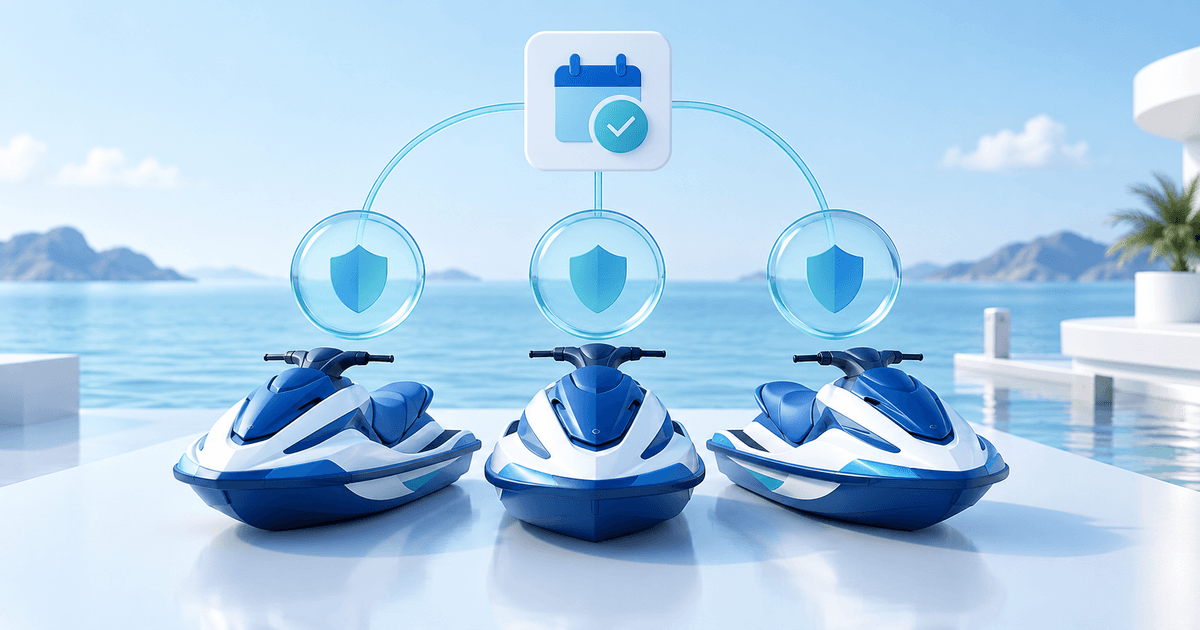
For a group jet ski booking, decide who is responsible for each craft before collecting a deposit. One reservation can contain several watercraft, several drivers and one payer. Those roles are not automatically interchangeable, and a paid group rental does not prove that every required damage hold is authorized.
This guide adds an original craft-to-deposit register for small watersports teams. It helps staff choose between separate authorizations and one agreed combined hold without claiming that PayRequest manages driver eligibility or rental liability.
Choose the responsibility model first
Your reviewed rental agreement should identify the renter, permitted drivers, responsible payer and claim conditions. A group organizer paying the hire charge has not automatically consented to every participant's damage liability. Get the appropriate agreement and authorization; applicable consumer, maritime and payment rules vary.
Deposit amounts are operator-specific. Pure Watersports' FAQ describes a $1,000 hold per jet ski. Treat that as one business's policy, not a recommended amount for your fleet or a guarantee that every card can support a large group hold.
Build a three-craft deposit register
For fictional booking GROUP-614, three jet skis each require €500 of damage security under the agreed terms. The proposed total is €1,500. Keep the agreement, drivers and condition evidence in your rental system; use the payment references to connect them to the money state.
| Craft | Responsible party under the agreement | Deposit record | Return decision owner |
|---|---|---|---|
| JS-01 | Agreed renter A | Separate €500 authorization, or part of agreed combined hold | Named dock staff member |
| JS-02 | Agreed renter B | Separate €500 authorization, or part of agreed combined hold | Same inspection coordinator |
| JS-03 | Agreed renter C | Separate €500 authorization, or part of agreed combined hold | Same inspection coordinator |
This is a worksheet, not a built-in vessel-assignment feature. Check the actual authorized state, amount and deadline for every required record before departure. The multiple-deposit queue supports the broader operational handover.
Compare separate holds with one combined hold
Separate authorizations can give each agreed payer a clear record and permit an independent final decision per craft. They also require more customer actions and more simultaneous active-deposit capacity. Check your account allowance and pricing; a plan supporting one active hold is not enough for three concurrent holds.
A combined €1,500 authorization may fit a genuinely agreed single responsible payer. It requires enough available card balance and a complete group-return review. It does not remove the need to identify which craft and claim a charge concerns. PayRequest does not automatically divide the hold among drivers or make a group organizer liable.
Stripe's authorization rules make the actual provider deadline important in either model. Do not assume one successful authorization means all three separate requests succeeded.
Avoid settling the combined hold too early
Suppose JS-01 returns first with a supported €40 accessory charge, while JS-02 and JS-03 are still out. In the documented PayRequest Stripe flow, capturing €40 from the combined €1,500 authorization finalizes it and releases €1,460. The remaining funds cannot support a later second capture on that same authorization.
Wait for the complete agreed group inspection before one final combined decision, provided it fits the real deadline. If independent return times need independent decisions, separate holds may better match the agreed arrangement. Never delay or invent a charge merely to avoid authorization expiry. The partial-capture explanation covers the finality.
Give staff and customers distinct instructions
For the group organizer: “Booking GROUP-614 has [rental payment] and [agreed damage-security arrangement]. Please complete the indicated payment and authorization steps before [departure review]. The deposit reserves available card funds; the rental payment is charged.” Adapt this to your real agreement rather than sending one customer's request as a public universal link.
For dock staff: check rental-payment success, each required authorization, craft allocation and the complete return record separately. Keep waivers, licences and driver checks in the system that owns them. For payment setup, use PayRequest security deposits alongside payment links.
Begin with one representative group, review available card funds and active-hold capacity, and rehearse the final decision before a busy weekend. The Stripe cost worksheet and weather-cancellation table cover the other two common dock decisions.
Editorial note: AI assisted with the text and illustrative cover. Sources were reviewed on 14 October 2026. GROUP-614, the craft register and all amounts are fictional; no legal endorsement, automatic allocation or live payment test is claimed.