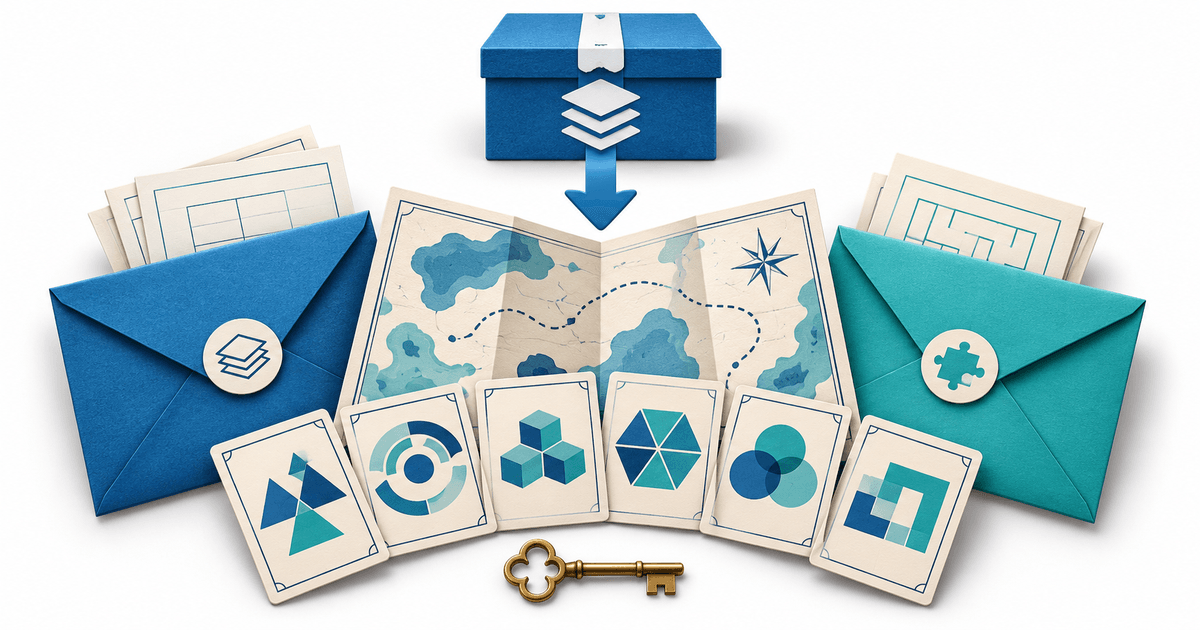
You can sell a printable escape room game as a downloadable package: the buyer pays, downloads the files and prints the game at home. The product needs more than puzzles. Give the host setup instructions, players spoiler-free sheets and both a clear description of the equipment and licence required.
Here is a worked example for an independent puzzle creator launching one original home game. Every quantity, price and cost below is hypothetical. It is a product-planning exercise, not a customer story, live checkout test or revenue result.
Start with one complete play session
Our fictional product is The Missing Observatory Key: a six-puzzle game for one household, intended for ages twelve and up, with a target playing time of forty-five to sixty minutes. Those are design targets to validate before selling, not tested claims.
The creator chooses a paper-only route: ordinary printer, scissors and pencils, with no real locks, app login or paid subscription required to play. This reduces the setup the buyer must arrange. If your game needs padlocks, a colour printer or an online puzzle page, disclose that before purchase.
The buyer-facing promise is one complete activity. It is not “eighteen pages of content” in isolation. Page count helps explain the package, but the actual value is a game a host can prepare and run.
Turn the idea into a delivery manifest
The creator plans eighteen printable pages and a small readme file. Keep player material separate from solutions so the host can print the right pages without revealing the ending.
| File | Planned contents | Pages | Buyer use |
|---|---|---|---|
| Start-here.pdf | Materials, print settings, setup and reset | 3 | Host reads before preparing |
| Player-pack.pdf | Six puzzle sheets, clues and ending | 10 | Print for players |
| Host-solutions.pdf | Answers, hint order and troubleshooting | 4 | Host keeps private |
| Licence.pdf | Household use, copying and support terms | 1 | Buyer checks permitted use |
| Readme.txt | File list, version and contact route | Not printable content | Find help and identify the release |
The total is 3 + 10 + 4 + 1 = 18 pages. Package the approved files into one ZIP so the product description, download and support instructions all refer to the same release.
A household licence is the choice in this example. If you sell to teachers, party hosts or commercial venues, define those permissions separately. Do not label a household purchase as a commercial licence or imply that buying the file transfers your copyright.
Decide what must pass before launch
The following is a proposed acceptance matrix. It records checks the creator still needs to perform, not tests PayRequest has run.
| Check | How to reproduce it | Release decision |
|---|---|---|
| Print fit | Print every player page at the stated A4 and US Letter settings | No cropped clue, cut line or instruction |
| Black-and-white use | Print in grayscale | Colour is not the only way to solve a clue |
| Puzzle path | Ask someone unfamiliar with the answers to follow the rules | No missing dependency or unreachable answer |
| Hint sequence | Run each hint before the full solution | Earlier hints do not accidentally reveal later puzzles |
| Spoiler separation | Open files as a new host would | Solutions are clearly separated |
| Reset | Reassemble a second set from the supplied files | Consumable pages and extra copies are explained |
Do not advertise the target age or duration as observed until you have a basis for it. If a playtester needs an explanation absent from the instructions, revise the product rather than treating that explanation as optional support.
Use your own puzzles, illustrations and story, or assets whose licences allow this distribution. A popular fictional franchise is not automatically available for a commercial game theme.
Work out the price with transparent assumptions
Suppose the creator chooses a €12 selling price, spends 12 hours preparing the first release and values that preparation at €25/hour. The initial time-cost allowance is 12 × €25 = €300.
For each order, assume an average of six minutes of support, also valued at €25/hour. The support allowance becomes 6 ÷ 60 × €25 = €2.50 per order. This is an assumption to replace with observed support work; it is not measured seller data.
Let p be the actual provider processing cost in euros per order. Leaving it as a variable avoids inventing a universal card or local-method rate.
Using Premium at €5/month with 0% standard platform fees while active, the contribution toward that month's preparation and subscription allowance is €12 − €2.50 − p = €9.50 − p per order. This excludes taxes, refunds, marketing and other expenses.
If the creator budgets all €300 of preparation plus one €5 subscription month against this launch, the planning break-even is round €305 ÷ (€9.50 − p) up to a whole order. At an explicitly assumed processing cost of €0.50 per order, that is €305 ÷ €9 = 33.89, rounded up to 34 orders. The €0.50 is a worksheet input, not a quoted provider rate. There is no claim those orders will occur.
If support averages twelve minutes instead, support costs €5 and contribution at the same assumed processing input falls to €12 − €5 − €0.50 = €6.50. The same allowance would need 47 orders. Improving unclear instructions can matter more than trimming a few cents from checkout costs.
Choose a selling route that matches your audience
A marketplace can put a game in front of shoppers, subject to its rules and discovery system. A direct download page fits a creator who already reaches puzzle fans through a newsletter, club, videos or an existing website. A payment page alone does not supply an audience.
The paid print-and-play escape-game catalogue on itch.io shows this is a purchasable product category. Its listing is not evidence of demand for your particular story or a reliable price benchmark.
Our example chooses a direct product page so the creator can present the exact materials, preview and licence together. The page should show a non-spoiler sample, the eighteen-page manifest, equipment, language, target age, preparation effort and whether updates are included.
Publish the package and make delivery clear
With PayRequest digital selling, create a digital product, upload the reviewed ZIP and provide a clear product description. Configure the buyer's download access and connect the supported payment provider for that workflow. Delivery follows confirmed payment; an uploaded file is not proof a real purchase has succeeded.
Current pricing lists digital products on Premium and Business. Complete account setup and activate the appropriate paid plan before relying on paid access. Provider fees remain separate. Verify provider eligibility for digital orders; do not infer it from a generic payment-link integration or fictional demo.
Before promotion, review the actual buyer-facing download instructions, expiry and download allowance. Do not promise lifetime access unless your configured service and terms support it. Download delivery also cannot stop someone copying files after receiving them.
Create one complete game product, keep the source files and release manifest, and use genuine buyer questions to improve the next version. Start with a package you can explain and support, rather than a bundle count you cannot maintain.
Editorial method: AI-assisted article and illustrative cover; product/pricing sources reviewed on 7 November 2026. The game, manifest, acceptance plan and worksheet are original hypothetical examples. No sales, playtest results or provider-rate quote is claimed.