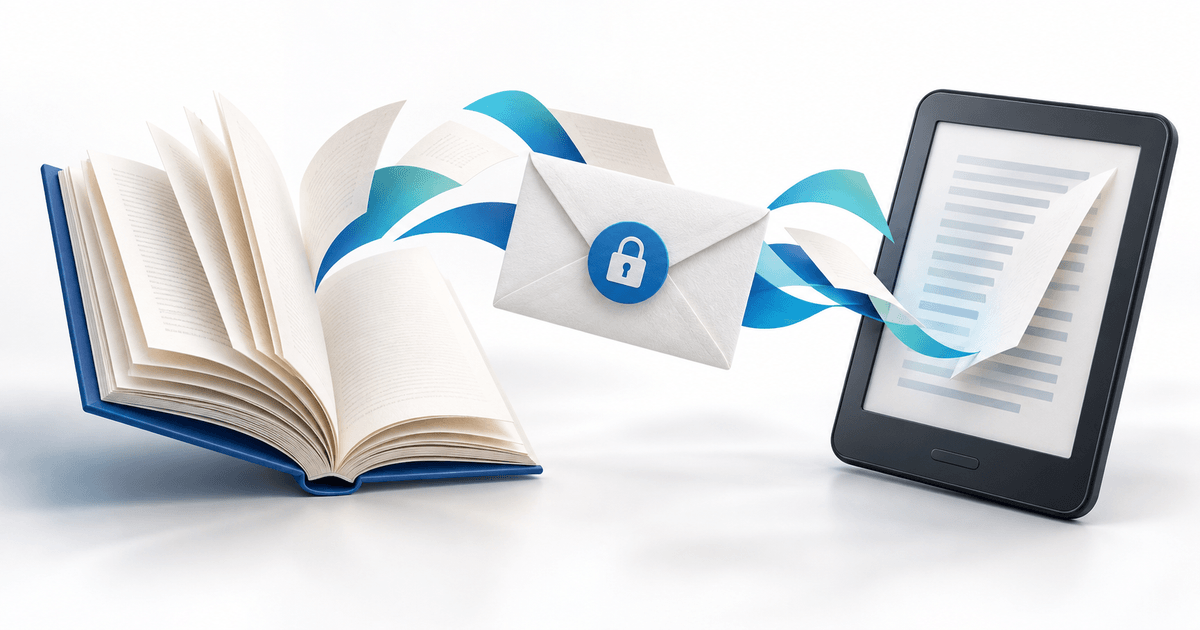
To sell an ebook EPUB file online, upload the finished book to a digital product, set its price and share the product checkout link. PayRequest delivers the purchased file after confirmed payment. Give buyers a clear route into their reading app: payment, download and reader import are separate steps.
This article is for independent authors who already have a finished book and an audience. The original handoff card below connects PayRequest's download behavior to the reader's next action. It is a proposed release protocol, not a claim that we tested your manuscript or every reading device.
How to sell an ebook EPUB file with PayRequest
Start with a finished EPUB you have the right to distribute, then create a digital-product offer that connects one book to its payment and download. You can share the public product link from an author website, newsletter or social profile. A separate website is optional; reaching readers remains your responsibility.
- Export and validate the final EPUB, including its cover, contents and book metadata.
- In PayRequest, start a new Digital product and choose the ebook/PDF category.
- Upload the approved EPUB. For several promised formats, package them in one ZIP and explain extraction.
- Add the title, edition, language, description, cover image, price and currency. State the buyer's permitted use and reader requirements.
- Configure the download allowance and expiry, then connect an eligible payment provider and check available methods for your account.
- Publish the offer and copy its actual public product URL. Open it logged out and compare the offer with the file you attached.
- Before promoting the link, perform an authorized purchase check and verify the delivered edition and reader instructions.
The current digital-product documentation describes supported EPUB, PDF and ZIP uploads, one file per product, and download links on the success page and in the order confirmation email. A multi-format bundle therefore needs a ZIP rather than an assumed multi-file attachment feature.
For example, a fictional €12 “Interview Guide — EPUB, edition 1” should deliver Interview-Guide-v1.epub. A separate workbook offer should use a different product link, even at the same price. Record that mapping in this original launch worksheet; these rows illustrate what to verify, not completed sales.
| Offer | Delivery artifact | Before launch |
|---|---|---|
| Interview Guide — EPUB | Interview-Guide-v1.epub | Title, language, price and final EPUB match |
| Interview Workbook — PDF | Interview-Workbook-v1.pdf | Separate product link and printable scope match |
| Guide and Workbook Bundle | Interview-Bundle-v1.zip | ZIP contains both approved files and instructions |
If you are still deciding which formats to offer, use EPUB versus PDF for selling ebooks. Once the offer is ready, the EPUB delivery and reader-import guide provides a copyable support message for buyers.
What does selling an EPUB ebook cost?
Check current PayRequest plans alongside your provider's fees. Free is €0 with a 2% standard platform fee per successful payment. Premium is €5/month and Business €20/month, with 0% standard platform fees while the paid plan is active. Provider fees and commission-payment exceptions remain separate.
For the illustrative €12 ebook, 2% is €0.24 before provider charges and other applicable costs. At 30 assumed sales in a month, that percentage totals €7.20. Compare it with Premium's €5 subscription for standard platform fees only; this is not a net-income forecast, and it assumes the paid plan is active for those sales.
Start with one clearly scoped ebook, one product URL and one checked customer route. Create your EPUB ebook product and use the release and handoff checks below before announcing it to readers.
Choose the File the Reader Will Actually Use
Offer a reflowable EPUB for a primarily text-based book when readers need adjustable text. A PDF can be a useful companion for a worksheet or fixed-layout reference, but label it separately. Do not promise that a PDF and EPUB will display identically.
Publish the formats, language, edition and any device limitations before checkout. If the product is a ZIP containing an EPUB and extras, explain that buyers must extract it first. A directly downloadable EPUB removes that extra step for a single-book offer.
PayRequest's current upload implementation accepts EPUB, PDF and ZIP. It delivers the file; it does not convert the manuscript, install a reading app or automatically add the book to an Amazon library. The ebook product page is the starting point for this offer. For the provider-specific setup, see selling ebooks with PayPal.
Validate an EPUB Before Selling It Directly
Run the exact retail file through EPUBCheck, the W3C project's EPUB conformance checker. Resolve errors and review warnings. A passing result checks conformance; it does not prove that navigation, image descriptions or reading order are useful to a human reader.
Open the same file in the apps you intend to support. Increase the font size, follow the contents navigation, move between chapters and test footnote return links. Look for clipped diagrams and missing characters. Record the app, operating system and date instead of advertising universal compatibility.
Keep a release record with book title, edition, filename, checksum and validation result. A corrected chapter should produce an identifiable new file so support can tell which edition the buyer opened.
Copy This Download-to-Reader Handoff Card
Use one row per promised reader path. The sample entries describe what to test, not completed tests.
| Stage | Buyer action | Evidence to record | If it fails |
|---|---|---|---|
| Purchase | Finish payment | Order and confirmed payment reference | Check payment status before asking for another payment |
| Download | Open delivery page and press download | Filename, edition and local file present | Distinguish expired link from a used download allowance |
| Import | Open or share the EPUB to the chosen reading app | App/version and book visible in library | Provide instructions for that app, not a second checkout link |
| Reading | Open contents, chapter and footnote | Navigation works at enlarged text | Correct the EPUB or narrow the supported-reader claim |
The distinction matters in PayRequest: opening the download landing page does not itself consume a download. The actual download action checks expiry and the download allowance. An email scanner opening the landing page is therefore different from a buyer downloading the file. This behavior was verified in PayRequest's download controller on 9 September 2026.
Give Buyers an Honest Kindle Route
Amazon offers Send to Kindle as a separate document-transfer service. Direct-sale delivery should tell a Kindle reader to follow Amazon's current supported-format and account instructions. Do not describe PayRequest's delivery email as automatic Kindle delivery or promise that every layout survives conversion.
A short instruction can say: “Download the EPUB to your device, then use your reading app's import option. For Kindle, follow Amazon's Send to Kindle instructions. If the file downloads but will not import, tell us the app/device and book edition.” Never ask for the reader's Amazon password.
Set Up the Offer and Support Boundary
Create one digital product, attach the approved file and review file-delivery settings. Rehearse the buyer route using the final artifact before announcing it. Keep the release card outside PayRequest if you use it as a support log; it is an editorial worksheet, not an automatic platform feature.
Decide how existing buyers receive material corrections and how you handle expired access. Do not promise unlimited downloads when your configured allowance is limited. Protected delivery controls access to the download; it does not prevent a recipient from copying a file they have received.
Review current PayRequest pricing and your provider fees before setting your margin. Start with one book and one clearly documented reader route, then expand support only after testing it.
Editorial note: this article and its illustrative cover were created with AI assistance. The original delivery behavior was reviewed in September 2026. The October 2026 update adds the selling steps, launch worksheet, current plan comparison and format/support guides using official product documentation. The examples are planning tools, not completed purchases or device tests.