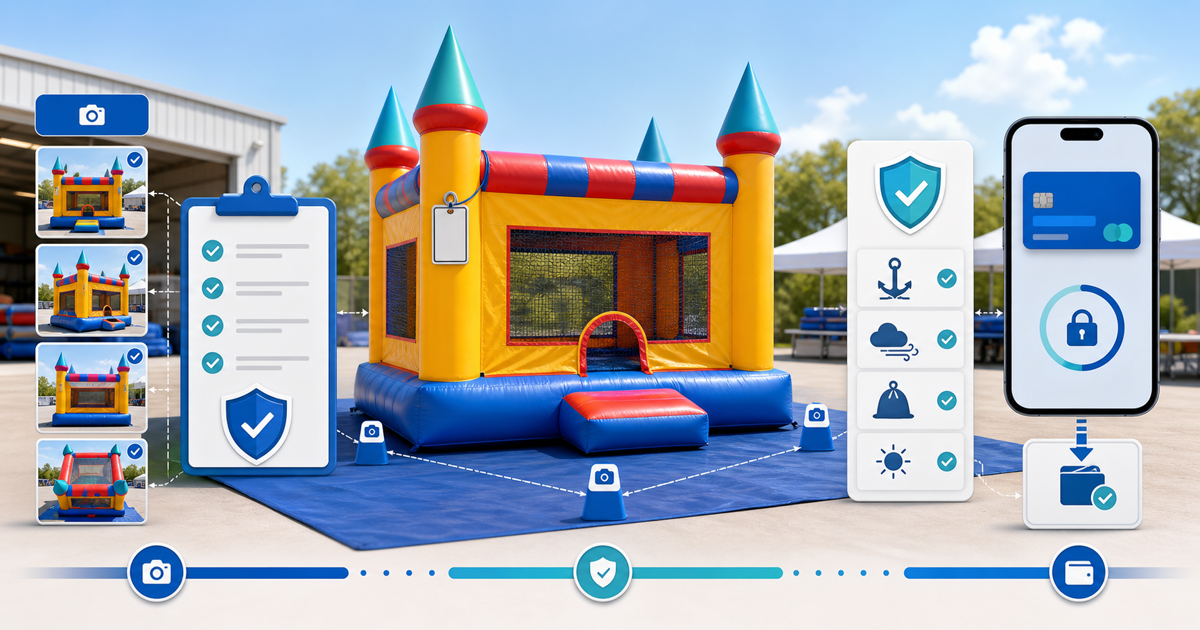
A bounce-house rental security deposit should cover disclosed, documentable loss or damage—not act as a shortcut for the separate safety decision. Identify the inflatable and accessories, photograph the same zones before and after the hire, record cleaning or damage exceptions, then release the hold or capture only a supported amount.
This checklist is for inflatable and party-rental operators. Its original asset is a two-lane closeout record that keeps financial evidence separate from anchoring, weather and qualified safety inspection.
Keep Deposit Evidence and Safety Control Separate
| Deposit lane | Safety lane |
|---|---|
| Asset identity, component count and condition | Manufacturer instructions and competent setup |
| Disclosed cleaning, missing-item and damage terms | Anchoring, blower, electrical and site checks |
| Before/after photos and itemized cost | Weather limits, supervision and shutdown decision |
| Release or supported partial/full capture | Remove from service, repair or approve for use |
The US Consumer Product Safety Commission's inflatable amusement safety bulletin says appropriate anchoring is essential and directs operators to manufacturer requirements and weather monitoring. That guidance is a safety source, not a deposit tariff. A clean financial checklist never certifies that an inflatable is safe.
Create One Asset-Level Handover Record
Record the unit ID, model, serial or internal asset number; blower, stakes or ballast, groundsheet, extension equipment and accessories; delivery and collection times; site/contact identity; and deposit authorization reference. Photograph the asset tag first so every later image stays connected to the correct unit.
Use repeatable views of the entrance, seams, netting, steps, floor, anchor points, blower tube and packed accessories. Note existing patches, marks and repaired areas. Never ask staff to infer new damage from memory after several visually similar units return together.
Define Chargeable Events Before Authorization
Separate ordinary cleaning and expected wear from exceptional contamination, prohibited use, missing components, cuts, damaged seams or other contractually covered events. Publish the calculation method and evidence route before the customer authorizes the hold. Local contract and consumer rules vary; this is an operational record, not legal advice.
A charge should connect five things: the identified unit, baseline condition, return condition, applicable term and itemized amount. If specialist assessment is needed, preserve evidence and work within the connected provider's authorization window rather than guessing a repair cost.
Use the Return Decision Card
| Result | Deposit action | Separate operational action |
|---|---|---|
| Complete and unchanged | Release promptly | Safety inspection still required |
| Normal soil within terms | Release | Clean and inspect |
| Missing accessory | Capture supported replacement amount, release remainder | Reconcile inventory |
| New damage requiring assessment | Document and review within hold rules | Quarantine the unit |
| Safety concern without renter-caused evidence | Do not invent a deposit claim | Remove from service and escalate |
Send the customer the unit identity, decision, evidence, amount calculation and release or capture reference. Do not describe an authorization release as a refund: no settled payment may have occurred.
Run the Hold in PayRequest
PayRequest security deposits can show a time-limited card authorization, its countdown and the eventual release or capture event. Link that event to the asset record, while keeping qualified safety and maintenance decisions in the operator's appropriate system.
The broader party-rental deposit guide covers mixed inventories. This article owns the inflatable-specific boundary between deposit evidence and anchoring, weather and return-to-service checks.
Close the job only when the customer receives the financial decision, the hold is released or supported capture is complete, inventory is reconciled and the separate safety lane has a named owner.