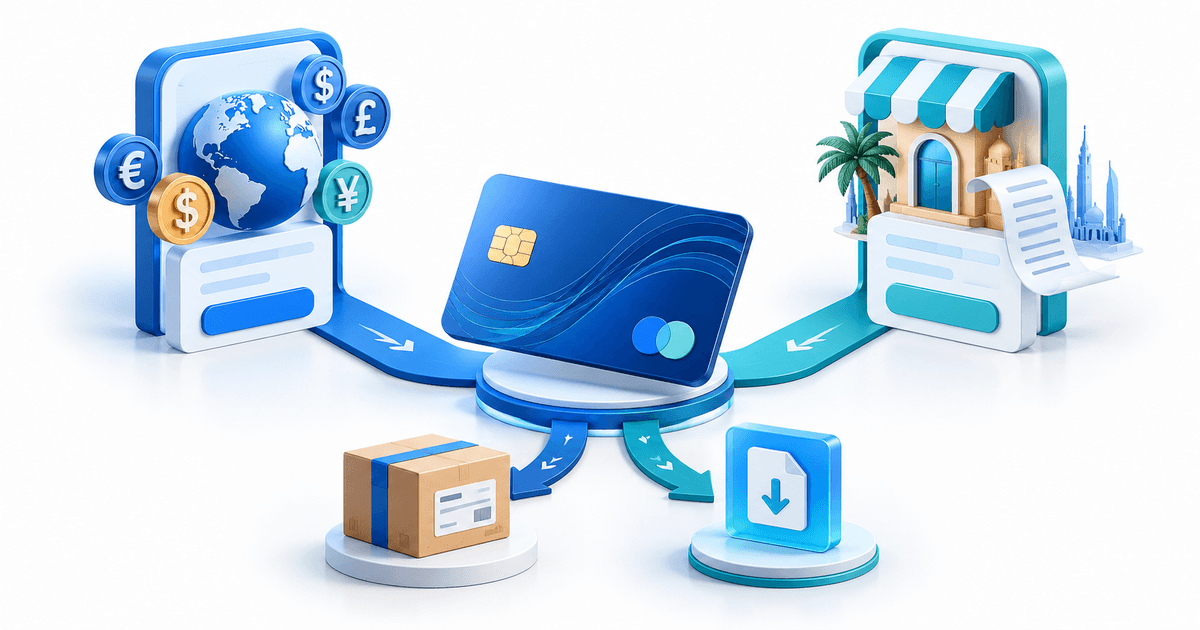
Choose a direct PayPal payment link when an eligible PayPal business account and its available checkout options meet your selling needs. Evaluate PayTabs PayLinks when its merchant-country support, acquiring arrangement and payment options fit your business. For eligible UAE merchants, the choice can also be PayPal inside PayTabs: the services are not always mutually exclusive.
This guide is for sellers taking remote orders by email, chat or social media. Compare who collects, who settles and who delivers the order before comparing headline fees. A payment-link feature does not establish that either supplier performs every part of your selling workflow.
Compare the three routes
PayPal's UAE payment-link page offers shareable checkout links without requiring a website. That is a merchant checkout product, not merely a personal PayPal.Me address. Confirm the methods and currencies available to your actual business account.
PayTabs PayLinks is a payment-link offering, with products and features varying by country. Ask for the country-specific merchant proposal and supported payment methods rather than assuming a regional brand means every local method is included.
| Route | What you are buying | What to verify |
|---|---|---|
| Direct PayPal link | Checkout through your eligible PayPal business account | Account eligibility, available methods, receiving currency and fees |
| PayTabs PayLinks | Link-based collection under your PayTabs merchant arrangement | Country onboarding, settlement, methods and applicable charges |
| PayPal through PayTabs | PayPal as an alternative payment method within an eligible arrangement | Activation, transaction support and separate PayPal settlement |
PayTabs' PayPal documentation currently describes availability for UAE merchants, requires active accounts with both providers and lists USD, EUR, GBP, HKD and JPY. It describes SALE transactions and settlement to the merchant's PayPal account. Do not infer AED support for that PayPal route from the fact that the merchant is in the UAE. Confirm the current arrangement directly before contracting.
A thirty-order routing worksheet
Suppose a seller expects thirty orders next month: eighteen one-off service orders and twelve downloadable products. These are hypothetical order counts, not customer results. The split tests what happens after payment rather than predicting conversion.
Complete this worksheet for each proposed route:
| Order group | Collection requirement | Work still to assign |
|---|---|---|
| Eighteen service orders | Correct customer, price, currency and payment reference | Delivery date, completion confirmation and any invoice requirement |
| Twelve downloads | Correct product and confirmed successful payment | File access, delivery email, support and access policy after a refund |
| A payment made through PayPal inside PayTabs | Identify its actual payment route | Match the PayPal settlement instead of expecting a second PayTabs payout |
If six of the thirty orders use PayPal inside PayTabs, there are still thirty orders, not thirty-six. Record both the order ID and the provider transaction reference, and reconcile the actual settlement destination. Adding an alternative method is not an extra sale and should not inflate your order report.
For digital products, neither a return-page redirect nor a screenshot proves successful payment. Require a confirmed payment record before granting access. Confirm whether the selling platform automates this handoff or whether staff must do it. The payment-link pages alone do not establish secure file delivery.
Compare a written quote with the same order mix
Avoid a universal “cheapest” verdict. Merchant country, payment route, currency conversion, settlement and refund charges can change the result. A directory's headline percentage may describe a different region or payment product.
Use this budget structure:
For thirty equal orders of amount A and a quoted rate r plus fixed charge f, the processing component is 30 × (A × r + f), provided every order actually uses that rate. For a mixed route, calculate each group separately. Ask whether enabling PayPal through PayTabs creates additional platform charges and how refunds are initiated and recorded. This formula deliberately uses quote inputs instead of inventing a current universal PayTabs rate.
Compare in one currency using an explicitly dated exchange-rate assumption if needed. Settlement currency and advertised checkout currency are different purchasing questions; writing a currency on an order does not establish the net amount arriving in your bank.
Ask for one complete order, including an exception
Before committing, have the supplier show a successful order, an unfinished checkout and a refund. For each, record the customer message, order status, provider record, settlement destination and delivery state. This is a proposed buying protocol, not a performed test.
If recurring collection is essential, verify a separate subscription agreement and authorization workflow. A repeatable one-off link does not itself authorize future charges. If local acquiring, a particular local method or physical terminals drive your purchase, evaluate those directly with the relevant provider.
Where PayRequest fits
PayRequest payment links can provide the surrounding collection workflow using supported connected providers, including PayPal. It is worth evaluating when you want to organize seller links and payment records around an eligible account you control. PayRequest does not offer a PayTabs connection or replace PayTabs' local acquiring arrangement.
If the twelve downloads are the real pain point, evaluate digital-product delivery with one supported file and your intended provider. Check file and plan requirements before moving a catalogue. Keep manual service fulfillment assigned to your own team.
Current PayRequest pricing separates platform charges from provider charges: Free has a 2% standard payment fee; active paid plans have 0% standard platform fees, with provider fees and commission-payment exceptions separate. Adding a workflow layer does not make PayPal processing free.
Create an account, connect an eligible provider and build one representative seller link. Review currency, checkout and the actual delivery handoff before sharing it with customers.
Editorial note: AI assisted the text and illustration. Primary sources were checked on 27 October 2026. The thirty-order worksheet is hypothetical; no live vendor test, savings or customer conversion result is claimed.