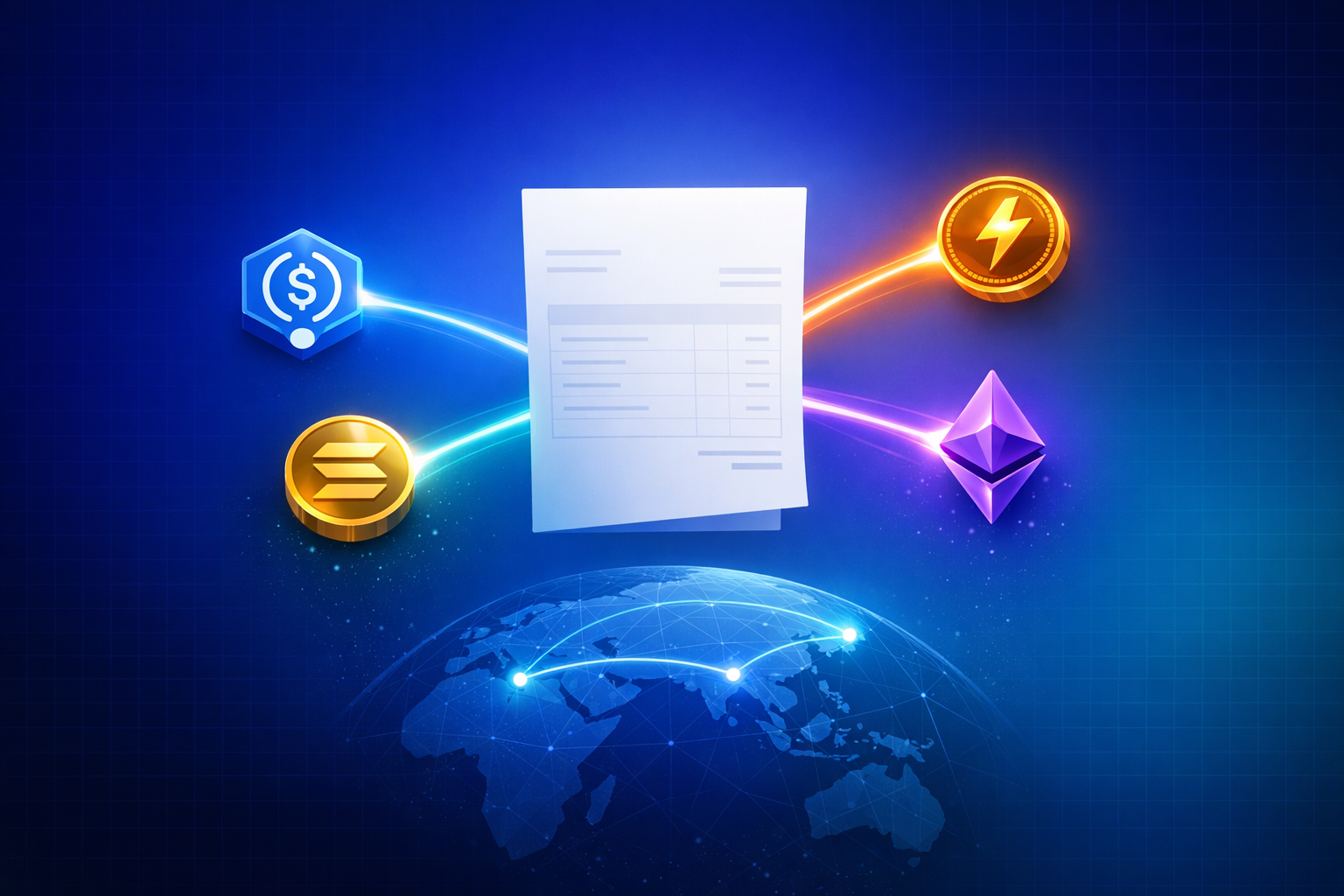
Your client is in Tokyo. Your bank is in Amsterdam. The wire costs EUR 35 and takes five business days. The exchange rate at your bank is three percent below mid-market. By the time the funds arrive, you have spent EUR 50 in total friction on a EUR 2,000 invoice, and your client has paid EUR 25 on their end too. That is EUR 75 of value destroyed so a payment can travel from one bank to another.
Now consider the alternative. You send an invoice that includes a USDC payment option. Your client opens Coinbase Wallet, scans a QR code, confirms the transaction, and the USDC settles on Base in under two seconds. The network fee is EUR 0.003. No intermediary, no currency-conversion spread, no three-day wait for the clearing house to process the transfer. The invoice is paid before your client closes their laptop.
This is not a future possibility. This is how a growing number of freelancers, SaaS companies, agencies, and digital product sellers are invoicing their international clients in 2026. And you do not need to write a single line of code or deploy a smart contract to do it.
Key Takeaways
- No-code crypto invoicing turns a standard invoice into a hosted checkout page that accepts BTC, ETH, USDC, SOL, and fiat methods from a single link
- Stablecoins like USDC eliminate the FX volatility problem that made early crypto invoicing impractical for businesses
- Invoicing with crypto costs pennies per transaction instead of the EUR 20-50 typical of international wire transfers
- Fiat-crypto convertible invoices let clients pay in whatever method they prefer while you receive settlement in your chosen currency
- EU businesses are fully covered by MiCA regulation in 2026: accepting crypto for goods and services is legal without a crypto license
The Problem with Traditional Invoicing for International Businesses
Invoicing across borders has not changed meaningfully in forty years. The core mechanism is still a payment instruction sent from one bank to another through a network of correspondent relationships, each taking a cut and adding a delay.
A EUR 5,000 invoice from a Dutch agency to a US client passes through at least three banks. The client's US bank charges a wire fee (EUR 25-45). The SWIFT correspondent takes a handling fee (EUR 10-25). The receiving bank in the Netherlands charges an inbound wire fee (EUR 5-15). Currency conversion adds another 2-4 percent depending on the bank's spread. The total cost of getting paid: EUR 150-250.
On a crypto invoice, the fee is the network gas paid by the sender's wallet. On Base or Solana, that is under EUR 0.01. On Ethereum mainnet, it is EUR 2-10. Even on the most expensive chain, crypto invoicing costs two orders of magnitude less than the correspondent-banking alternative.
International wires take one to five business days. SWIFT payments are not settled on weekends or public holidays. If your client initiates a payment on Friday afternoon in Tokyo, you will not see it in your account before Wednesday — assuming no compliance holds.
Crypto invoices settle in the time it takes for the blockchain to finalize a block. Solana finalizes in under a second. Base and Polygon finalize in under two seconds. Even Bitcoin via Lightning Network settles in milliseconds. The delay is measured in seconds, not days.
When you invoice in your currency and your client pays in theirs, one of you absorbs the exchange rate. Most small businesses invoice in their own currency and let the client deal with conversion, which adds friction to the payment experience. Some use mid-market rates and invoice in USD or EUR, but the conversion at the receiving bank is rarely at a competitive rate.
Crypto sidesteps this entirely. Stablecoins are dollar-denominated digital assets. A EUR 5,000 invoice converted to approximately USD 5,450 at the prevailing rate and requested in USDC avoids the bank FX spread entirely. The conversion from USDC back to EUR happens at exchange-competitive rates (0.1-0.3 percent spread instead of 2-4 percent).
What Is No-Code Crypto Invoicing?
No-code crypto invoicing means creating a professional invoice that includes crypto payment options alongside traditional methods, using a visual interface rather than API calls or smart contract development.
Crypto-native invoicing platforms like Request Network operate on-chain. Every invoice is a blockchain transaction, every payment request is a smart contract interaction, and every audit trail lives on a public ledger. This is powerful for Web3-native teams but requires wallet signatures for routine actions and introduces gas costs for every invoice created.
No-code crypto invoicing works differently. The invoice itself lives off-chain as a standard document with a payment page attached. When the client chooses to pay in USDC, the platform generates a payment address, detects the on-chain confirmation, and forwards the funds to your wallet. You create invoices through a dashboard interface — the same way you would create a standard invoice or payment link. The blockchain complexity stays hidden.
A no-code invoicing platform with crypto support handles four things automatically. Wallet address management: you connect your wallet once and every crypto invoice routes payments to the right destination. Multi-chain detection: the platform detects which blockchain the customer used and maps the transaction to the correct invoice. Fiat conversion or forwarding: depending on your preference, the platform either forwards the USDC directly to your wallet or converts it to EUR. Customer receipts: the client receives a confirmation email with the transaction hash and block explorer link.
Cryptos You Can Accept on Invoices
Not all cryptocurrencies work well for invoicing. The choice depends on what your clients hold and how much you care about settlement speed, cost, and volatility.
USDC is a regulated stablecoin issued by Circle, pegged 1:1 to the US dollar and audited monthly. On Base, Coinbase's Layer-2 network, USDC transfers cost under EUR 0.01, confirm in under two seconds, and integrate directly with Coinbase's exchange liquidity. This is the default recommendation because it eliminates volatility risk while keeping settlement fast and cheap.
Base processed over 800 million transactions in 2025 and has never suffered an outage or reorg that affected USDC settlement. For businesses issuing more than ten invoices per month, USDC on Base is the most reliable crypto invoicing rail available in 2026.
Solana offers the fastest settlement of any major blockchain. Transactions finalize in 400-800 milliseconds at a cost of approximately EUR 0.002. Phantom and Solflare wallets are widely used in the Solana ecosystem, and the chain has deep USDC liquidity through Jupiter.
Solana is the right choice if your client base overlaps with the Solana ecosystem — NFT creators, Solana DeFi users, or builders in the Solana app ecosystem. The trade-off is that Solana's history of network disruptions (though much improved since 2024) makes some risk-averse businesses prefer Base for mission-critical payments.
USDT (Tether) has higher global trading volume than USDC and is the dominant stablecoin in Latin America, Southeast Asia, and parts of Eastern Europe. Polygon provides cheap settlement (under EUR 0.01) and broad wallet compatibility. Tron is even cheaper (under EUR 0.005) but has less institutional acceptance.
Bitcoin on-chain is impractical for invoicing — confirmations take ten to sixty minutes and fees spike to EUR 10-50 during congestion. Lightning Network changes this. Payments settle in milliseconds at near-zero cost and the network has grown to over 5,000 BTC in capacity by 2026.
Bitcoin invoicing via Lightning is relevant if your clients are Bitcoin-native — common in SaaS products serving crypto companies, Bitcoin education platforms, or privacy-focused services. Lightning invoices are single-use, meaning each invoice generates a unique payment request that cannot be intercepted or replayed.
Ethereum mainnet invoices are not practical for amounts under EUR 500 — gas fees of EUR 2-10 eat too much of the payment. But ETH on Base or Polygon costs under EUR 0.01 and confirms in seconds. If your client specifically wants to pay in ETH rather than a stablecoin, accepting ETH on an L2 is the practical path.
Traditional Invoice vs Crypto Invoice: Side by Side
| Dimension | Traditional International Wire | Crypto Invoice (USDC on Base) |
|---|---|---|
| Settlement time | 1-5 business days | Under 2 seconds |
| Transaction fee | EUR 25-50 (plus FX spread) | Under EUR 0.01 |
| FX conversion spread | 2-4 percent (bank rates) | 0.1-0.3 percent (exchange rates) |
| Chargeback risk | Can be reversed up to 180 days | Zero chargebacks (irreversible) |
| Global reach | Limited to SWIFT-connected banks | Any wallet globally |
| Weekend/holiday support | Blocked | 24/7/365 |
| Client experience | Bank login, IBAN, reference field | Wallet scan, confirm |
| Reconciliation | Manual (statement matching) | Automatic (transaction hash) |
| Compliance friction | KYC/AML holds common | No intermediary holds |
| Minimum viable amount | EUR 50 (below which fees dominate) | EUR 1 (gas is negligible) |
The table makes the strategic difference clear. Crypto invoices do not just reduce cost — they change the geometry of who you can invoice. A EUR 50 payment to a freelancer in Nigeria costs EUR 30 in wire fees. With a crypto invoice, it costs under EUR 0.01 and settles instantly. This unlocks international micro-transactions that are economically impossible on traditional rails.
How to Send a Crypto Invoice Without Code
Sending an invoice that accepts crypto payments takes five minutes from a fresh account. Here is the step-by-step flow using PayRequest.
Generate a crypto wallet address. If you already have a Coinbase, MetaMask, or Phantom wallet, you already have an address. If not, create one — it takes two minutes and does not require buying any crypto. Navigate to PayRequest's crypto payments settings, click Connect Wallet, and authorize the connection. The platform reads your wallet address and stores it for forwarding incoming payments. You only do this once.
Click Create Invoice in the PayRequest dashboard. Enter the client name, invoice number, line items, quantity, and total. The interface is identical to creating a standard invoice. Under Payment Methods, toggle on the crypto assets you want to accept — USDC on Base, Bitcoin Lightning, ETH on Base, Solana USDC, and any combination of fiat methods.
There is no separate workflow for crypto. It is a checkbox on the same invoice creation form. This is what no-code means: you do not add blockchain complexity; you add a payment method.
The invoice generates a URL. This URL is the invoice itself — a hosted payment page with your branding, the line items, and every accepted payment method displayed as options. Send the link via email, embed it in a messaging app, or add it to a client portal.
When the client opens the link, they see a professional invoice layout with payment method buttons. They choose USDC, and the page displays a QR code and a wallet-connect button. They scan with their mobile wallet or click Connect Wallet on desktop, review the amount, and confirm.
The platform detects the on-chain transaction within seconds, matches it to the invoice, marks the invoice as Paid, and forwards the funds to your wallet. You receive a payment confirmation email with the transaction hash and block explorer link. From your perspective, the workflow is the same as receiving a card payment.
How It Works for the Client
The client experience matters more than the mechanics. Crypto invoicing succeeds when the buyer does not need to understand blockchain to complete the payment.
If your client does not use crypto, they ignore the crypto payment buttons entirely. The invoice offers credit card, iDEAL, SEPA, or PayPal alongside the wallet options. They pay with their preferred method, the payment goes through Stripe or Mollie, and the EUR lands in your bank account. The crypto options exist as an alternative, not a requirement.
If your client uses crypto, they tap the USDC or BTC button, connect their wallet, and confirm the transaction. The payment page detects their wallet type (MetaMask vs Phantom vs Coinbase Wallet) and adjusts the connection flow accordingly. The QR code option lets mobile wallet users complete the payment by scanning from their phone.
The client receives an email receipt with the invoice details, payment confirmation, and on-chain transaction hash. If they paid in USDC, the receipt shows the USD amount at the time of payment and the equivalent in their local currency. The blockchain complexity is invisible.
Fiat-Crypto Convertible Invoices: The Killer Feature
The single most useful capability in modern crypto invoicing is the convertible invoice: you send one invoice, and the client chooses whether to pay in fiat or crypto. The settlement arrives in your chosen currency regardless.
You create an invoice with a EUR total, say EUR 2,500. The platform shows payment options for credit card, iDEAL, PayPal, and USDC on Base. The client selects USDC, and the platform calculates the equivalent in USDC at the current market rate (EUR 2,500 = approximately USD 2,725). The client's wallet shows a request for 2,725 USDC. They confirm, the transaction settles on-chain, and the platform converts the USDC to EUR and deposits EUR 2,500 into your bank account.
You never held crypto. Your accounting stays in EUR. The client paid with their preferred crypto wallet. The platform absorbed the conversion.
Convertible invoices solve the adoption problem that killed earlier crypto payment experiments. Between 2017 and 2022, the standard approach was: accept crypto, hold it, and hope it goes up. This was speculation disguised as payment processing. It created tax complications, volatility risk, and a terrible user experience for merchants who just wanted to get paid in their local currency.
The convertible invoice restores the proper relationship: crypto is a payment rail, not an investment asset. You accept it because it is faster and cheaper than the alternatives, not because you want to hold a digital asset on your balance sheet. The conversion from USDC to EUR happens at the point of settlement, so your books reflect your operating currency consistently.
Tax and Accounting for Crypto Invoices
The regulatory environment for crypto payments in the EU matured significantly in 2025-2026. Here is what businesses need to know.
The EU's Markets in Crypto-Assets regulation (MiCA) came fully into effect in 2025. Under MiCA, businesses that accept crypto as payment for goods and services are not classified as crypto-asset service providers (CASPs). You do not need a MiCA license to invoice clients in crypto. The license requirement applies to exchanges, custodians, and brokers — not to merchants accepting payment.
For VAT purposes, a crypto payment is treated the same as a payment in EUR. The taxable amount is the EUR equivalent of the crypto at the time of the transaction, calculated at a verifiable exchange rate from a major exchange like Coinbase or Kraken at the block timestamp. Your standard VAT rate applies.
You report crypto revenue as income in EUR using the exchange rate at the time of receipt. Your accounting platform or billing dashboard should record the EUR equivalent for every crypto transaction automatically. If it does not, capture the exchange rate at the block timestamp from a reputable oracle.
If you hold crypto rather than converting immediately, you create a cost basis event. The EUR value at receipt becomes your cost basis for future capital gains calculations. Most businesses avoid this complexity by auto-converting to EUR at settlement.
Starting in 2026, the EU's DAC8 directive requires crypto-asset service providers to report transactions above EUR 1,000 to tax authorities. If you use a hosted invoicing platform that forwards crypto to your wallet, the platform may have reporting obligations under DAC8. Ensure your platform provides transaction records and EUR-equivalent valuations for every payment.
Who Should Use Crypto Invoices
Crypto invoicing is not for every business. It solves specific problems for specific profiles.
A freelance developer in Portugal billing clients in the US, UK, and Singapore is the ideal user. Wire fees on three to five monthly invoices add up to EUR 150-300 per month. Crypto invoices eliminate these fees entirely, and instant settlement means no cash flow gap from waiting for wires to clear.
SaaS businesses with international subscribers benefit from crypto invoicing in two ways: reduced payment processing costs on large annual contracts (where wire fees are painful) and zero chargeback risk on crypto payments. For SaaS serving crypto-native customers, accepting USDC via wallet is a competitive advantage.
Agencies billing EUR 5,000-50,000 monthly retainers across multiple currencies lose significant margin to FX spreads and wire fees. Crypto invoices settle in USDC at near-zero cost, and auto-conversion to EUR eliminates FX tracking overhead.
Ebook authors, course creators, and template sellers with international customers face a specific problem: payment processing fees can eat 15-30 percent of a EUR 10-50 digital product sale. Crypto invoices at under EUR 0.01 per transaction make micro-transactions viable. A EUR 15 ebook paid in USDC costs EUR 0.003 in network fees instead of EUR 0.60-1.50 in card processing fees.
Getting Started with No-Code Crypto Invoicing
The setup time for no-code crypto invoicing is under ten minutes. You need a wallet address (generate one in Coinbase, MetaMask, or Phantom in two minutes) and a PayRequest account. Connect the wallet in the crypto payments settings, set your auto-conversion preference, and create your first invoice with crypto payment options enabled.
Every invoice you create from that point forward offers every payment method you have enabled. Clients see the methods they recognize. Crypto-native clients pay with their wallet. Everyone else uses the fiat methods they already trust. The invoice dashboard tracks all payments in one view, regardless of whether the settlement came through Stripe, Mollie, PayPal, or a blockchain.
The pricing is the same as every other PayRequest payment: 2% per successful payment, capped at EUR 25 per transaction, with no monthly fee and no setup cost. Network gas fees are the customer's responsibility, and on Base or Solana, those are effectively zero.
The world of international invoicing is shifting. Banks built the current system for a world where payments took days because information traveled at the speed of mail. That world ended twenty years ago, but the payment infrastructure has been slow to catch up. Crypto rails are not a speculative experiment in 2026. They are faster, cheaper infrastructure for the specific problem of getting paid across borders.
Your next invoice can offer Bitcoin, Ethereum, USDC, and Solana alongside cards and bank transfers. The client chooses. You get paid. And you never wrote a line of code.
Create your PayRequest account now and send your first crypto invoice in under five minutes. No code. No smart contracts. No blockchain experience required.