Late payments cost European B2B businesses an average of €25,000 per year in lost revenue and administrative overhead. When invoices go unpaid, most businesses face the same uncomfortable choice: absorb the loss or hand the account to an external collection agency that takes 15–25% of whatever they recover.
There is a third option. Running debt collection in-house gives you full control over the process, preserves client relationships, and keeps 100% of recovered revenue. The challenge has always been that in-house collection requires systems — escalation frameworks, legal compliance knowledge, and the discipline to follow through consistently.
This guide walks you through a complete in-house debt collection process for B2B businesses. You will learn the 5-stage escalation framework, how to calculate Dutch collection fees (incassokosten), when to offer payment plans versus writing off bad debt, and how billing software like PayRequest automates the entire workflow from first reminder to final recovery.
Key Takeaways
- External collection agencies charge 15–25% commission — handling collection in-house saves thousands annually
- A structured 5-stage escalation framework turns ad-hoc chasing into a repeatable process
- Dutch law (WIK) allows you to charge standardized collection fees starting at 15% on the first €2,500
- Pre-incasso is legally required before escalating to formal collection or charging fees
- Payment plans and partial payments recover more revenue than rigid all-or-nothing demands
- Self-service customer portals reduce disputes and accelerate payment by 40%
Why B2B Businesses Should Handle Collection In-House
Most businesses default to external collection agencies because the process feels unpleasant and time-consuming. Nobody started a hosting company or design agency to chase unpaid invoices. But the economics of outsourcing debt collection rarely make sense for B2B businesses with recurring client relationships.
When you hand an invoice to a collection agency, you are paying for their infrastructure, staff, and profit margin — all deducted from money that was already yours. The standard commission structure in the Netherlands looks like this:
| Recovery Stage | Agency Commission | Your Recovery |
|---|---|---|
| Amicable (pre-legal) | 15–20% | 80–85% |
| Legal proceedings | 20–25% + court fees | 75–80% minus fees |
| Bailiff execution | 25%+ plus execution costs | <75% |
On a €10,000 overdue invoice recovered through amicable collection, you lose €1,500–€2,000 in commission. Add the registration fee (€25–€50 per case) and administrative time preparing the handover, and the true cost often exceeds 25% of the invoice value.
Beyond the financial cost, external agencies damage client relationships. A hosting provider who sends their agency after a client over a delayed €500 invoice risks losing a customer worth €6,000 per year in recurring revenue. The agency does not know — and does not care about — that context.
In-house debt collection does not require legal expertise or dedicated staff. What it requires is a system. The four elements of an effective internal collection operation are:
Structured escalation. A predefined sequence of actions triggered automatically as invoices age. No manual decision-making about what to do next.
Legal compliance. Understanding of your rights under Dutch law (WIK) and the formal requirements for charging collection fees. This is simpler than most businesses assume.
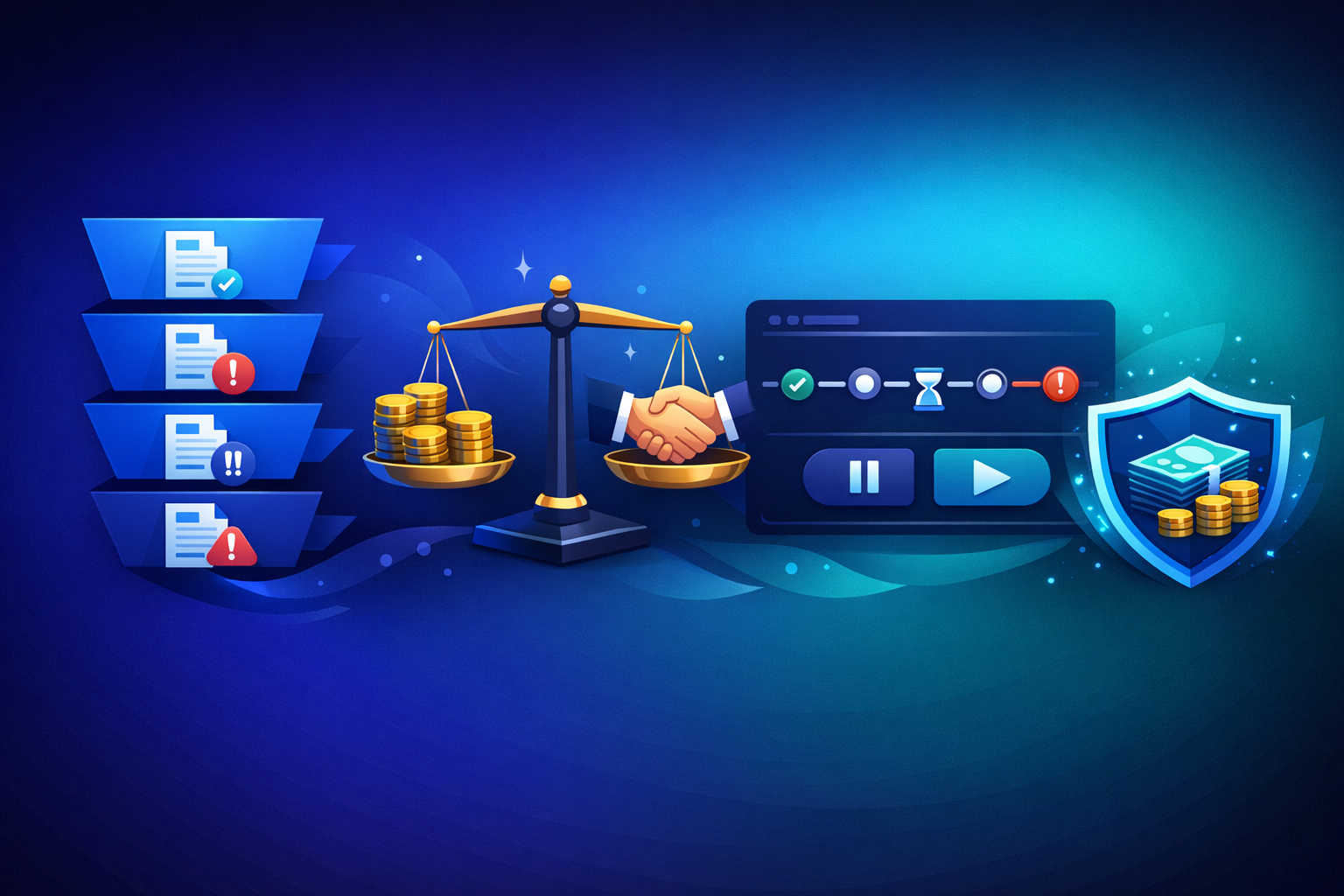
Flexible resolution tools. The ability to pause escalation, accept partial payments, offer payment plans, or waive balances — because not every case follows the same path.
Complete documentation. An audit trail of every reminder, response, and action. This protects you legally and provides evidence if escalation to court becomes necessary.
With these four elements in place, a business owner or office manager can manage collection for dozens of overdue accounts in minutes per week rather than hours.
The 5-Stage Escalation Framework
The most effective approach to B2B debt collection is progressive escalation — starting friendly and increasing urgency over time. Each stage gives the client an opportunity to resolve the situation before the next step.
A well-designed escalation framework recovers 80–90% of overdue invoices before reaching the formal warning stage. The key is consistency: every overdue invoice follows the same path, with no exceptions and no manual intervention required.
Before any formal collection action begins, Dutch law requires a pre-incasso notice for B2B debts where you intend to charge collection fees. This is a formal written communication that:
- States the exact amount owed (including invoice number and original due date)
- Specifies the collection fees (incassokosten) that will be added if payment is not received
- Gives the debtor 14 days to pay before fees are applied
- Is sent via registered mail or email with delivery confirmation
The pre-incasso is both a legal requirement and an effective collection tool. Many clients pay immediately when they see the formal notice with calculated fees. PayRequest generates pre-incasso letters automatically with the correct WIK fee calculations.
After the initial payment terms expire, the escalation progresses through four stages:
Stage 1 — Friendly Reminder (Day 1–3 overdue). A polite notification that payment is overdue. Tone: helpful, assuming the client simply forgot. Include a direct payment link and the original invoice. No mention of fees or consequences.
Stage 2 — Second Reminder (Day 7–14 overdue). A firmer message noting this is the second reminder. Reference the original invoice and first reminder. Tone: professional but direct. Offer to discuss payment difficulties. Include a one-click payment link.
Stage 3 — Formal Warning (Day 21–30 overdue). A formal notice that the account is significantly overdue. Mention that continued non-payment will result in collection fees and potential escalation. Attach the pre-incasso notice with the WIK fee schedule. Tone: firm and factual.
Stage 4 — Final Notice (Day 30–45 overdue). The last communication before escalation to legal proceedings or external collection. State clearly that this is the final opportunity to resolve the debt without additional costs. Include the total amount with calculated collection fees. Provide a deadline (typically 7 days).
The timing between stages matters. Research from the European Payment Report shows that 67% of B2B debts recovered internally are paid within the first 14 days of follow-up. By day 30, recovery rates drop below 50%. The escalation framework front-loads effort when it is most likely to work.
How to Calculate Collection Fees (Incassokosten)
Dutch law provides a standardized fee schedule that businesses can charge for overdue B2B invoices. Understanding this schedule is essential for both compliance and maximizing recovery.
The Wet Incassokosten (WIK) establishes maximum collection fees based on the outstanding principal amount. These fees are not arbitrary — they are legally defined and enforceable.
| Outstanding Amount | Fee Percentage | Maximum Additional Fee |
|---|---|---|
| First €2,500 | 15% | €375 |
| Next €2,500 (€2,500–€5,000) | 10% | €250 |
| Next €5,000 (€5,000–€10,000) | 5% | €250 |
| Next €190,000 (€10,000–€200,000) | 1% | €1,900 |
| Above €200,000 | 0.5% | €3,225 |
Minimum fee: €40 (even on very small invoices).
Example calculation: For a €7,500 overdue invoice:
- 15% on first €2,500 = €375
- 10% on next €2,500 = €250
- 5% on remaining €2,500 = €125
- Total collection fee: €750
This €750 is added to the original invoice amount, making the total claim €8,250. The collection fee covers your administrative costs for chasing the payment.
To charge incassokosten legally, three conditions must be met:
First, the payment must be overdue. The invoice must have passed its due date and the standard payment term in your general terms and conditions.
Second, a pre-incasso notice must have been sent. The debtor must have received a formal notice specifying the fees and a 14-day payment deadline. Without this notice, collection fees are not enforceable.
Third, the 14-day period must have expired without payment. Only after the deadline in the pre-incasso notice has passed can you add the collection fees to the outstanding amount.
For B2B relationships, it is advisable to include a reference to your collection fee policy in your general terms and conditions (algemene voorwaarden). While the WIK applies regardless, having it in your terms strengthens your legal position and sets clear expectations.
Managing Difficult Cases — Pause, Partial Payments, and Write-Offs
Not every overdue invoice follows a clean escalation path. Some clients are experiencing genuine financial difficulty. Others dispute the invoice. A rigid all-or-nothing approach loses revenue in both cases.
Pausing the dunning sequence is the right choice when a client communicates proactively about payment difficulties, provides a credible plan for resolution, or when the relationship value significantly exceeds the overdue amount. Pausing is not ignoring — it is a deliberate decision to hold escalation while maintaining the debt on record.
Common scenarios for pausing:
- Client requests 30 additional days and has a history of reliable payment
- A dispute needs investigation before continuing collection
- The client is a key account worth significantly more in annual revenue than the overdue amount
- Seasonal businesses with known cash flow cycles
PayRequest's pause and resume functionality lets you freeze escalation for any account, with automatic resumption after a specified period. The invoice remains flagged as overdue, but no further reminders are sent until the pause expires or you manually resume.
Partial payments are better than no payment. When a client pays €3,000 of a €5,000 invoice, the worst response is to reject it because it is not the full amount. Accept the partial payment, reduce the outstanding balance, and continue collection on the remainder.
Effective partial payment strategies include accepting any amount the client offers to pay immediately, recalculating collection fees on the remaining balance only, and offering structured payment plans for the outstanding amount. PayRequest tracks partial payments automatically and adjusts the outstanding balance, dunning stage, and collection fee calculations in real time.
Sometimes writing off an unpaid invoice is the smartest business decision. Waiving the balance makes sense when the client is demonstrably insolvent with no prospect of recovery, the remaining amount is too small to justify further administrative effort, the cost of legal proceedings would exceed the potential recovery, or preserving the client relationship for future revenue outweighs the current loss.
In the Netherlands, written-off debts are tax-deductible. Document the write-off with a clear reason, keep records of all collection attempts, and record the deduction in your administration. PayRequest's waive balance feature records the write-off with a timestamped reason, creating an audit trail for your accountant and tax filings.
Self-Service Customer Portal for Overdue Invoices
A customer portal transforms debt collection from a push process (you chasing the client) to a pull process (the client resolving it themselves). This single change reduces disputes, accelerates payment, and eliminates back-and-forth emails.
When a client logs into their PayRequest portal, they see a complete overview of their account status. Outstanding invoices are highlighted with clear due dates and overdue indicators. Each invoice includes a one-click payment button — no searching for bank details or payment links in old emails.
The portal also shows the escalation stage, any collection fees that have been applied, and the total amount due. This transparency reduces disputes because clients cannot claim they were not informed. Every reminder, notice, and fee is documented and visible.
Offering payment plans through the customer portal lets clients resolve large overdue amounts on their own terms. Instead of negotiating over email or phone, the client selects a plan that works for their cash flow.
Effective payment plan structures for B2B collection include splitting the total over 2–4 monthly installments, requiring the first installment immediately as a sign of good faith, and automating subsequent payments via SEPA Direct Debit or recurring card charge. A €6,000 overdue invoice split into three monthly payments of €2,000 is far more likely to be recovered than a single demand for the full amount. The client gets breathing room, and you get certainty through automated recurring charges.
How PayRequest Automates In-House Debt Collection
Running collection in-house does not mean running it manually. PayRequest's debt collection feature automates the entire workflow from first reminder to final recovery, while giving you full control over every decision.
When an invoice passes its due date, PayRequest automatically starts the escalation sequence. The first friendly reminder is sent on day 1. If the client does not respond, subsequent reminders follow your configured schedule. Pre-incasso notices are generated with the correct WIK fee calculations. Collection fees are applied automatically when the 14-day deadline expires.
At every stage, you can intervene. Pause escalation for a specific client. Accept a partial payment and adjust the remaining balance. Offer a payment plan through the customer portal. Or waive the remaining balance if recovery is not worth pursuing. The automation handles the routine; you handle the exceptions.
Every action in the collection process is logged in a unified timeline. Reminders sent, client responses, partial payments received, escalation stage changes, pauses, resumes, fee calculations, and write-offs — everything is recorded with timestamps and the person or system that initiated the action.
This audit trail serves three purposes. It provides evidence for legal proceedings if collection escalates to court. It gives your accountant clean records for tax deductions on written-off debts. And it protects your business by proving that you followed proper procedure at every step.
The payment matching feature closes the loop by automatically reconciling bank transfers to outstanding invoices. When a client pays via SEPA transfer, PayRequest identifies the payment, updates the invoice status, and stops the dunning sequence — without anyone lifting a finger.
Frequently Asked Questions
External B2B collection agencies in the Netherlands typically charge 15–25% commission on recovered amounts. This means recovering a €10,000 invoice costs you €1,500–€2,500 in fees. Many agencies also charge upfront registration fees of €25–€50 per case. By handling collection in-house with automated tools like PayRequest, you eliminate these costs entirely and keep 100% of recovered revenue.
Pre-incasso is a formal written notice required under Dutch law (WIK) before you can charge collection fees on overdue invoices. It must state the exact amount owed, specify the collection fees that will be added, and give the debtor 14 days to pay. Send it when an invoice is 21–30 days overdue, before escalating to the final warning stage. PayRequest generates pre-incasso notices automatically with the correct fee calculations.
Yes. Under the Wet Incassokosten (WIK), you can charge standardized collection fees for overdue B2B invoices. Fees start at 15% on the first €2,500 of the outstanding amount, with a minimum of €40. You must send a formal pre-incasso notice and wait 14 days before applying fees. Including your collection fee policy in your general terms and conditions (algemene voorwaarden) strengthens enforceability.
Start immediately but gently. Send a friendly reminder 1–3 days after the due date — many late payments are simply oversights. Follow up with a firmer reminder at 7–14 days. Issue a formal warning with pre-incasso at 21–30 days. Send a final notice at 30–45 days. The European Payment Report shows that 67% of internally recovered B2B debts are paid within the first 14 days of follow-up.
Yes, especially for larger amounts. Payment plans recover significantly more revenue than rigid demands for full payment. Splitting a €5,000 overdue invoice into 3 monthly installments of €1,667 makes it manageable for clients with temporary cash flow issues. Automate the plan with recurring payments via SEPA Direct Debit to ensure follow-through.
Consider writing off (kwijtschelding) a debt when the client is genuinely insolvent, the remaining amount is too small to justify further effort (typically under €100), legal proceedings would cost more than the potential recovery, or the client relationship value far exceeds the overdue amount. Document every write-off with a reason — in the Netherlands, written-off debts are tax-deductible.
Taking Control of Your Cash Flow
Handling debt collection in-house is not about being aggressive — it is about being systematic. A structured escalation framework, clear communication, and the flexibility to adapt to each situation recovers more revenue than outsourcing ever could. You keep 100% of what you recover, maintain control over client relationships, and build a process that improves over time.
PayRequest gives you every tool you need: automated escalation sequences, pre-incasso generation with WIK fee calculations, pause and resume controls, partial payment tracking, payment plans through the customer portal, balance write-offs with audit trails, and automatic payment matching for bank transfers.
Stop paying agencies to chase your money. Start your free trial and take control of your billing recovery today.