Your customer just received their fifth billing email this week. Not from five different companies — from you. A hosting invoice on Monday, a domain renewal on Tuesday, an SSL certificate charge on Wednesday, and a backup subscription on Thursday. Friday brings a payment failure notification for the domain invoice because the timing overlapped with their rent payment.
They do not call to ask about the failed payment. They do not log in to update their card. They start researching your competitors.
This is the billing noise problem, and it is costing subscription businesses more customers than most realise. Not through dramatic cancellations or angry emails, but through a slow erosion of trust and patience that eventually tips the scale toward "this is not worth the hassle."
Key Takeaways
- Customers with multiple subscriptions can receive 8–12 billing emails monthly from a single provider
- Billing confusion is a leading driver of involuntary churn in subscription businesses
- Each separate invoice creates a separate opportunity for payment failure
- Consolidated invoicing reduces billing emails by 60–80% while improving payment success rates
- A self-service customer portal eliminates most billing-related support tickets
The Hidden Cost of Billing Noise
Billing noise is what happens when your invoicing system treats each service as an independent entity, disconnected from the customer relationship. Every service gets its own invoice, its own payment notification, its own receipt, and — if payment fails — its own dunning sequence. The customer's inbox fills with messages that all say the same thing in slightly different ways: "you owe us money."
A typical B2B customer with four recurring services from your business receives the following emails in a single billing cycle:
- Invoice #1247 for Hosting Plan — €29.00
- Payment confirmation for Invoice #1247
- Invoice #1248 for Domain Renewal — €14.00
- Payment confirmation for Invoice #1248
- Invoice #1249 for SSL Certificate — €49.00
- Payment failed notification for Invoice #1249
- Payment retry notification for Invoice #1249
- Payment confirmation for Invoice #1249 (retry succeeded)
- Invoice #1250 for Backup Service — €9.00
- Payment confirmation for Invoice #1250
That is ten billing-related emails for a customer who simply wants to use your services and not think about payments. Each email requires a micro-decision: is this important? Do I need to do something? Should I file this? After the third email, most customers stop reading them entirely — which means they also miss the one email that actually requires their attention.
Every confusing billing email is a potential support ticket. Common questions that flood support inboxes when businesses send individual invoices:
"I just paid you last week, why am I getting another invoice?" — The customer does not realise they have four separate subscriptions with different billing dates.
"Which invoice is this payment for?" — The customer made a bank transfer for the approximate total, and now neither they nor your finance team can match it to the right invoice.
"Why did my payment fail? I have money in my account." — The €49 SSL invoice hit on the same day as their office rent, causing a temporary insufficient funds situation that would not have occurred if the total had been lower or the timing different.
Each support ticket costs time, money, and goodwill. Multiplied across hundreds of customers, billing confusion becomes one of your largest hidden support costs.
How Invoice Overload Drives Involuntary Churn
Involuntary churn — customers who leave not because they decided to, but because the billing process broke down — accounts for 20–40% of all subscription churn. And billing complexity is one of its primary drivers.
When you send four separate invoices to a customer, you create four separate opportunities for payment failure. Each failed payment triggers its own dunning sequence: retry attempts, reminder emails, and eventually a suspension or cancellation warning.
The probability maths works against you. If each individual transaction has a 95% success rate (which is typical for SEPA Direct Debit), four separate transactions give you a combined success rate of 0.95⁴ = 81.5%. That means roughly 1 in 5 customers will experience at least one payment failure per billing cycle — not because they cannot afford your services, but because the payment processing hit a temporary snag on one of four attempts.
With a single consolidated invoice, that same 95% success rate applies once. One transaction, one chance of failure, one simple resolution if it does fail.
Churn is rarely a single-event decision. It is the accumulation of small frustrations that eventually tip the balance. Billing noise contributes to this accumulation in ways that do not show up in your churn analytics:
The customer receives a €9 payment failure notification, feels annoyed, and resolves it. Next month, the same thing happens with a different invoice. The month after, they get a dunning email that feels aggressive for a €14 domain charge. Each incident is minor. Together, they paint a picture of a company that cannot get billing right.
When that customer evaluates competitors — even if your actual service is superior — the billing experience weighs heavily. "At least with [competitor], I get one bill and it just works" is a real thought process that drives switching decisions.
Consider a hosting provider with 500 customers and a monthly churn rate of 3%. If billing confusion contributes to even 20% of that churn, that is 3 customers per month lost to preventable billing friction. At an average customer lifetime value of €1,200, that is €3,600 per month or €43,200 per year in revenue lost to billing noise.
Compared to the cost of implementing consolidated invoicing — essentially zero with the right billing platform — the ROI is immediate and significant.
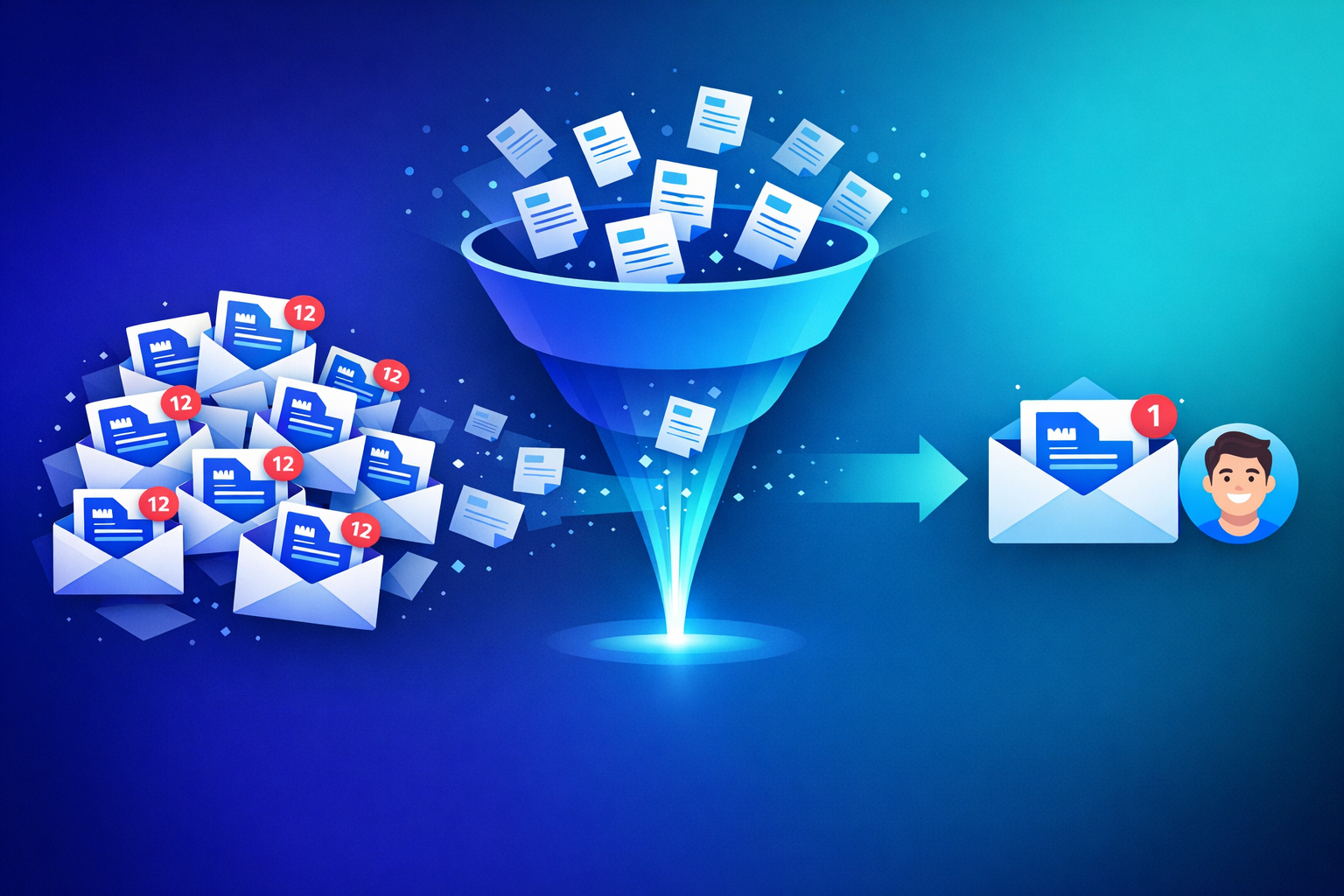
From 12 Emails to 1: What Consolidated Invoicing Changes
Consolidated invoicing replaces the per-service billing model with a per-customer model. Instead of generating an invoice for each product or subscription independently, the system bundles all charges into a single invoice per customer per billing cycle.
With consolidated invoicing, that same customer with four services receives:
- One invoice listing all services with clear line items — €101.00 total
- One payment processed via their preferred method
- One confirmation that everything is paid
Three emails instead of ten. One payment to make or one direct debit to process. One record to file for accounting. The billing relationship goes from noisy and confusing to clean and professional.
A well-designed consolidated invoice is actually more informative than individual invoices. The customer sees their complete relationship with your business on a single page:
| Service | Period | Amount |
|---|---|---|
| Business Hosting Plan | Mar 1 – Mar 31, 2026 | €29.00 |
| Domain: example.nl | Mar 15, 2026 – Mar 15, 2027 | €14.00 |
| SSL Wildcard Certificate | Mar 1, 2026 – Mar 1, 2027 | €49.00 |
| Daily Backup Service | Mar 1 – Mar 31, 2026 | €9.00 |
| Total | €101.00 |
The customer immediately understands their total spend, sees exactly what they are paying for, and can identify any charges they want to question — all without cross-referencing multiple emails and invoice PDFs.
Consolidation does not just reduce email volume — it fundamentally improves payment success rates. One transaction instead of four means:
- Higher success probability: 95% for one charge vs 81.5% for four independent charges
- Simpler dunning: If payment fails, one retry sequence instead of four overlapping ones
- Clearer communication: "Your invoice of €101.00 needs attention" is more actionable than "Invoice #1249 of €49.00 failed"
- Better timing: One charge at a predictable time is easier for customers to plan for than four charges scattered across the month
Consolidated Invoicing as a Customer Retention Strategy
Billing experience is increasingly a competitive differentiator. In markets where product features are similar, the operational experience — how easy you are to do business with — tips the decision.
Sending one clean, consolidated invoice signals operational maturity. It tells the customer that you have your systems together, that you respect their time, and that you have invested in making the business relationship smooth. This perception extends beyond billing into how they view your entire operation.
Conversely, sending multiple invoices with different amounts and dates — especially when some fail and trigger dunning emails — signals disorganisation. Fair or not, customers judge the quality of your product by the quality of your billing experience.
Annual renewals are the highest-risk moment for customer churn. It is the point where the customer actively decides whether to continue. If their experience throughout the year has been one clean invoice per month, paid seamlessly, with a customer portal where they can review everything — the renewal decision is easy.
If their experience has been a stream of confusing invoices, occasional payment failures, and support tickets about billing — the renewal is the moment they act on that accumulated frustration.
For B2B businesses that compete in formal procurement processes, billing simplicity is often an explicit requirement. Enterprise procurement teams want to deal with one invoice per vendor per month. If your competitor offers consolidated invoicing and you do not, you lose on an evaluation criterion that has nothing to do with your actual product quality.
How PayRequest's Customer Portal Eliminates Billing Confusion
Consolidated invoicing reduces email noise. The customer portal eliminates billing confusion entirely by giving customers self-service access to everything they need.
The customer portal provides a branded dashboard where each customer can:
- View all current and past invoices (consolidated and itemised)
- Download invoice PDFs for their accounting
- See upcoming charges and renewal dates
- Update their payment method
- View payment history across all services
- Access any deposits or credits on their account
This self-service access means customers do not need to email your support team to get a copy of last month's invoice, check when their domain renews, or update an expired card. The information is always available, always current.
Without a portal, billing is reactive. The customer receives an invoice, maybe pays it, maybe has a question, contacts support, waits for a response. Every interaction is initiated by a problem.
With a portal, billing becomes proactive. The customer checks their portal before charges are due. They see the upcoming consolidated invoice, verify the line items are correct, and ensure their payment method is current. Problems are prevented rather than resolved.
Businesses that implement both consolidated invoicing and a customer portal typically see a 50–70% reduction in billing-related support tickets. The combination addresses the two root causes of billing support volume: confusion (too many invoices) and lack of access (cannot find information without contacting support).
PayRequest's portal includes automatic dunning integration. If a payment fails, the customer sees the status in their portal with a clear "update payment method" button — no support ticket required. If subscriptions are approaching renewal, the portal shows the upcoming charge, giving customers time to prepare.
FAQ
A B2B customer with 4 recurring services typically receives 4 invoices, 4 payment confirmations, and potentially 2–4 additional emails for payment failures and reminders — totalling 8–12 billing emails per month from a single provider. Consolidated invoicing reduces this to 2–3 emails.
Yes. Billing complexity is a significant driver of involuntary churn. Each separate invoice creates a separate point of failure, and accumulated billing friction drives customers to competitors with simpler billing experiences. Even a 20% reduction in billing-related churn can save tens of thousands annually.
Consolidated invoicing combines all of a customer's charges into one invoice with detailed line items. Invoice batching sends multiple invoices at the same time but keeps them separate. Consolidation reduces transaction count and fees; batching only changes the timing of when invoices are sent.
Yes. A consolidated invoice lists every service as a separate line item with its own description, period, and amount. Customers see their complete relationship on one document — it is more transparent than individual invoices because everything is in context.
With PayRequest, you can enable consolidated invoicing immediately. Create customer subscriptions with multiple line items, and the system automatically generates one invoice per customer per billing cycle. Most businesses complete the transition within a day. Start a free trial to see it in action.
One Invoice, One Payment, One Happy Customer
The simplest way to improve your customer billing experience is to send fewer, better invoices. Consolidated invoicing does exactly that — bundling all charges into one clear document, processed with one transaction, confirmed with one email.
Your customers did not sign up for your service to manage invoices. They signed up for the value you provide. Every invoice email that clutters their inbox is a reminder of the administrative overhead of doing business with you. Reduce that overhead to one email per month, give them a self-service portal for everything else, and watch your support tickets drop and retention improve.
PayRequest includes consolidated invoicing, a branded customer portal, automated dunning, and payment matching — everything you need for a professional billing experience. All included at €20/month.
Start your free trial and give your customers the billing experience they deserve.